
Filing a car insurance claim doesn’t start in an office or on the phone—it starts the second you’re in an accident. What you do in those first chaotic minutes sets the stage for everything that follows. Your top priorities are simple: keep everyone safe, call 911 if anyone is hurt, and methodically gather the right information. Getting this part right is the bedrock of a smooth, successful claim with your insurer.
What to Do Immediately After a Car Accident
The moments after a crash are a blur of adrenaline and stress. It’s completely normal to feel disoriented, but your actions here are what count. First thing’s first: safety. Check on yourself and your passengers before you even think about the car. Once you're sure everyone in your vehicle is okay, check on the people in the other car.
If it’s a minor fender-bender and the cars are still drivable, get them out of the flow of traffic. Pull over to the shoulder or a nearby parking lot. This simple move prevents a second accident and keeps everyone out of harm’s way. But if a car can't be moved or there are serious injuries, leave everything as is and flick on your hazard lights.
Why You Should Always Call the Police
Even for a small collision, calling the police is one of the smartest things you can do. That official police report is a powerful, impartial document. Your insurance adjuster will lean on it heavily when figuring out who was at fault.
When the officer shows up, give them a clear, factual account of what happened. Stick to the facts and don't guess or admit fault. Before you leave, make sure you have the officer's name and the police report number. You'll need it later.
A police report is your claim’s best friend. It provides an unbiased, third-party account of the incident, often with a diagram, witness statements, and the officer’s initial take on fault. It's one of the most valuable pieces of evidence you can have.
Gathering Your Own Evidence at the Scene
While you wait for the police, it's time to become an investigator. This step is absolutely non-negotiable if you want to build a strong claim. You need way more than just a name and number.
Your smartphone is your best tool here. Snap clear pictures of the other driver's:
- Driver's License: This confirms their full name and address.
- Insurance Card: Get the company name and policy number.
- License Plate and VIN: The Vehicle Identification Number is usually on the dashboard (visible through the windshield) or on the driver's side door jamb.
Don’t forget to get their phone number, too. Being able to contact them directly can sometimes clear up small issues later on.
Car accidents are, unfortunately, a part of life on the road. In 2021 alone, there were about 4.2 private passenger auto collision claims filed for every 100 insured vehicles in the U.S. Knowing what to do can make all the difference, as detailed in these car insurance claims statistics from ConsumerAffairs.com.
To help you stay focused during a stressful time, we've put together a quick checklist. Keep it handy—you'll be glad you did.
Post-Accident Action Checklist
| Action Item | Why It Matters | Pro Tip |
|---|---|---|
| Check for Injuries & Call 911 | Health and safety are always the #1 priority. | Don't try to be a hero. Let the professionals handle any medical assessments. |
| Move to Safety (If Possible) | Prevents further accidents and keeps you out of traffic. | If you can't move the cars, turn on your hazard lights immediately. |
| Call the Police | An official report is crucial, unbiased evidence for your claim. | Be factual and calm. Avoid admitting fault or placing blame on the spot. |
| Exchange Information | You can't file a claim without the other driver's details. | Take photos of their documents. It's faster and more accurate than writing it all down. |
| Document the Scene | Photos create a visual record of damage and conditions. | Take wide shots of the scene, close-ups of the damage, and pictures of road signs or skid marks. |
| Talk to Witnesses | Independent accounts can strongly support your version of events. | Get their name and phone number. Ask if they'd be willing to give a brief statement to the police. |
| Do Not Admit Fault | Let the insurers and police determine fault based on evidence. | You can be sorry the accident happened without saying "it was my fault." |
Taking these steps protects you, your passengers, and the integrity of your future insurance claim. A little bit of calm, methodical work at the scene goes a long way.
Documenting Evidence for a Stronger Claim
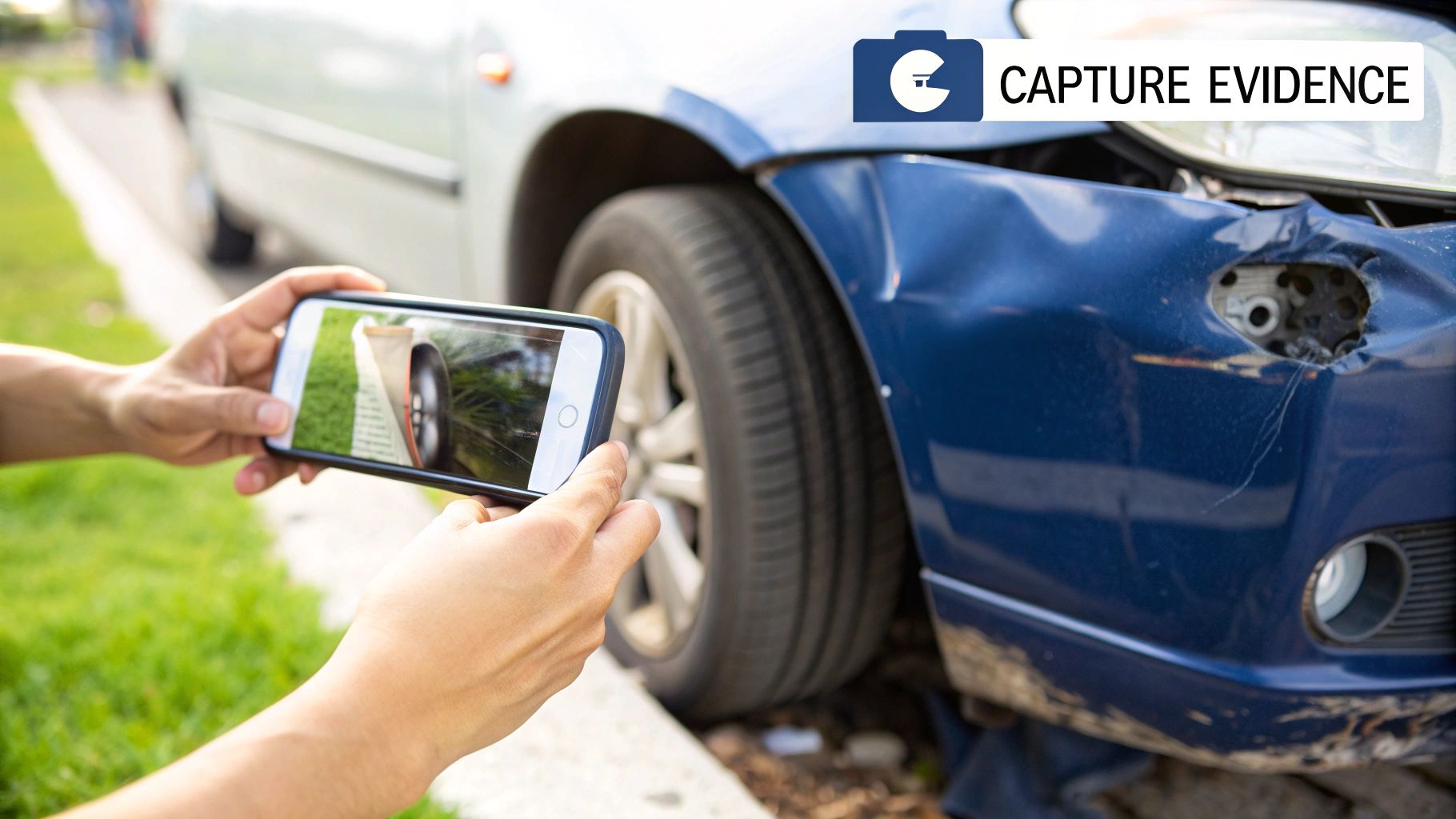
Once you've confirmed everyone is safe, your next job is to build the strongest possible case for your insurance claim. The evidence you collect in these first few moments tells the story your claims adjuster will use to process everything. Your smartphone is your single most important tool right now.
Think of it this way: effective documentation is about creating a clear, undeniable visual record. Don't just snap a couple of photos of a dented bumper. You need to build a complete picture that leaves no room for argument later on.
Capturing the Full Story with Your Camera
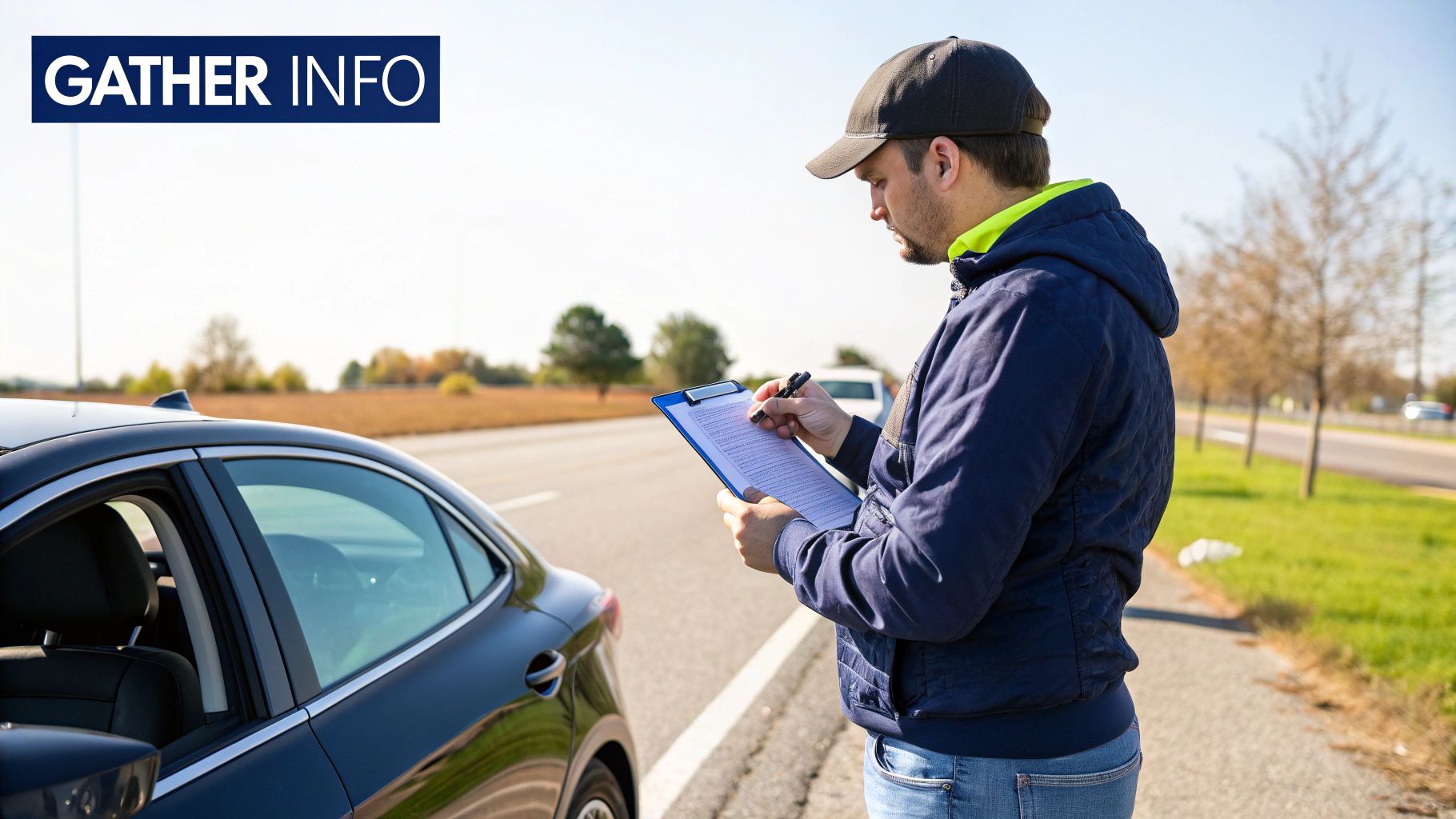
Start wide. Before you zoom in on the damage, take several wide-angle shots of the entire scene from different spots. You want to capture the final positions of all the cars, any nearby traffic lights or stop signs, and the general road conditions. This context is absolutely critical for establishing exactly how the accident happened.
After you have the big picture, move in for the details. Make sure you photograph the damage to all vehicles involved, not just your own.
- Get shots of any skid marks on the road.
- Document debris from the crash.
- Photograph any property damage, like a broken guardrail or a damaged mailbox.
- Always, always get a clear picture of every car's license plate.
Having this comprehensive photo library can shut down potential disputes before they even start, giving your claim a solid, factual foundation.
Here’s an example of the kind of clear interface you'll use to upload your evidence when you file your claim online.
Insurers like MyEasyRate have made the process incredibly straightforward. Having all your photos and information organized beforehand makes this part quick and painless.
The Power of Witnesses and Personal Logs
Photos are essential, but they don't always capture everything. This is where independent witnesses come in. Their unbiased perspective can be a huge boost to your version of events.
If anyone stopped to help or saw what happened, politely ask for their name and phone number. A neutral third-party account can be invaluable if the other driver tries to change their story later.
Beyond witnesses, you need to start your own log of everything related to the accident. This isn't just to jog your memory; it's a running, real-time record of your claim's entire journey.
Get a dedicated notebook or start a digital file to track every single interaction. Log every phone call with insurance reps, every doctor's appointment, and every single out-of-pocket expense. Make sure to note the date, time, who you spoke with, and a quick summary of the conversation. This log becomes your timeline, keeping you organized and in control.
This kind of detailed record-keeping does more than just strengthen your claim—it also helps you manage the financial recovery. By tracking your expenses, you can ensure you get properly reimbursed for everything. On that note, keeping tabs on your policy costs is always a smart move; you can learn more in our guide on how to lower car insurance costs. Every piece of paper, every photo, and every note adds another layer of strength to your case.
Starting Your Insurance Claim with Confidence
Okay, you've got your evidence lined up. Now it's time to get the ball rolling and officially open your claim.
Most modern insurers, including MyEasyRate, give you a few ways to do this. You can usually choose whatever feels easiest for you: kicking things off in a mobile app, logging into an online portal, or just making a direct phone call.
Whichever route you take, having your key info ready beforehand makes that first report go so much smoother.
Information You Need to File Your Claim
Before you tap that app or dial the number, do yourself a favor and pull these items together. It beats scrambling for a policy number while you're on the phone and ensures the first report is spot-on.
- Your Policy Number: This is the fastest way for them to find you in their system.
- The Police Report Number: Make sure you have the report number and know which police department or highway patrol agency responded to the scene.
- The Basics: Be ready with the exact date, time, and location of the accident.
- Other Driver's Info: This means their name, phone number, insurance company, and policy number.
- Your Notes & Photos: You won't be sending everything over just yet, but have your photos and notes handy so you can describe the incident accurately.
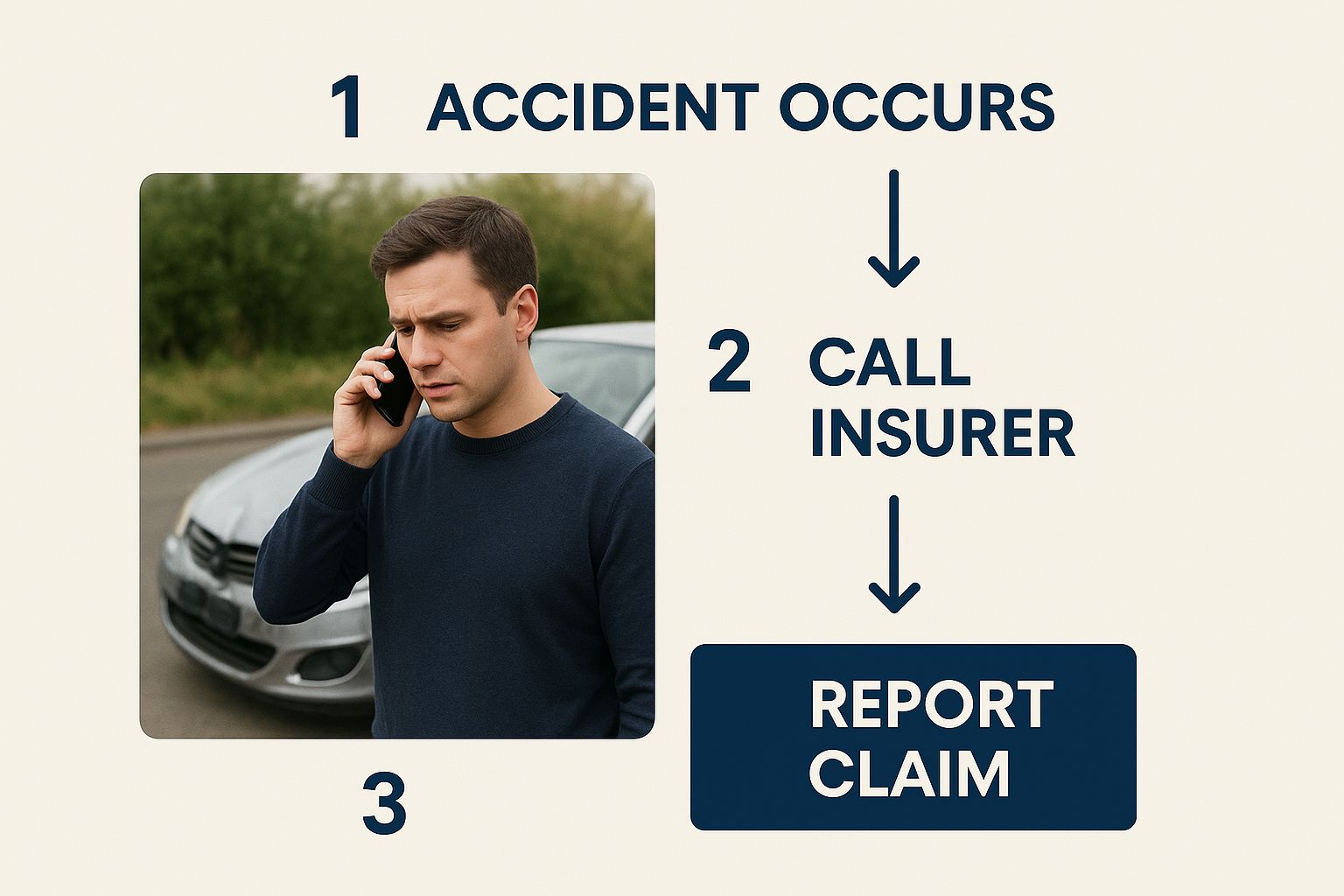
That first step—reporting the claim—is often the most important one you can take to get the process moving quickly.
Your First Conversation with the Insurer
This initial phone call or submission really sets the tone for your entire claim. When you speak to a claims representative, your only goal is to be clear, concise, and factual.
Lay out the information you gathered without injecting opinions or getting emotional. Just describe what happened.
A critical tip: avoid speculating on who was at fault. Simply state the facts as you experienced them. Let the evidence, the police report, and your eventual claims adjuster figure out liability. Admitting fault, even if you think you were partly to blame, can create major headaches for your claim later on.
Stick to the facts you documented. State what happened, describe the damage you can see, and mention if anyone was injured. A calm, factual report is your strongest opening move.
It's also worth remembering the bigger picture. The North American Property & Casualty insurance market, which includes auto policies, saw an 8.2% growth in 2024. This kind of industry-wide shift influences how insurers handle risk and process claims, making a well-documented case more important than ever.
What to Expect Next
Once you've made that initial report, the insurance company will assign a claims adjuster to your case. This person is now your main point of contact.
Their job is to review all the details, arrange for an inspection of your vehicle's damage, speak with any witnesses, and ultimately determine the settlement. You should expect to hear from your assigned adjuster within a few business days.
This is where knowing your policy limits comes in handy, especially when you're trying to manage costs. For drivers in South Florida, for instance, our guide to finding cheap auto insurance in Fort Lauderdale can provide some useful local context. This first report kicks off a structured investigation designed to get your claim settled fairly and get you back on the road.
Working Effectively with Your Claims Adjuster
Once you've filed your claim, it gets assigned to a claims adjuster. This is the person at MyEasyRate Insurance who becomes your main point of contact. Their job is to investigate the accident, determine who was at fault, and calculate a settlement based on your policy and the evidence.
It’s tempting to see the adjuster as an opponent, but that’s not productive. The best approach is to treat them as a professional you need to collaborate with. A smooth claim really comes down to clear, consistent communication.
Preparing for the Vehicle Inspection
First things first, the adjuster needs to see the damage to your car. This could be an in-person visit at your home or a local body shop. It's also becoming very common for insurers to handle this virtually, asking you to upload photos and videos through a smartphone app.
No matter how it happens, you need to be ready.
- Clean Your Car: Seriously. A clean car makes it much easier for the adjuster to spot every single scratch and dent. You don't want minor damage overlooked.
- Have Documents Ready: Keep your police report number handy. If you’ve already gone out and gotten an estimate from a body shop you trust, have that ready, too.
- Be There if You Can: For an in-person inspection, your presence is invaluable. You can point out things the adjuster might miss, like a weird rattle that started after the crash or a door that doesn't quite shut right anymore.
This inspection is a big deal. The adjuster’s report from this assessment is what they'll use to put together their initial settlement offer.
Communicating to Protect Your Interests
The way you talk to the adjuster can make a huge difference. You absolutely should be honest and cooperative, but remember their job is to close the claim fairly—and for a reasonable cost to the insurance company.
When you discuss the accident, stick to the facts. Don't guess, don't apologize, and don't admit any fault. Avoid emotional phrases. For example, instead of saying, "I panicked and didn't see the other car," just state the facts: "The other vehicle entered the intersection and struck the passenger side of my car."
Let your documentation—the photos, the police report, any witness info—do the heavy lifting. Keep your conversations focused and factual.
Understanding Repair Estimates vs. a Total Loss
Based on the inspection, the adjuster will decide if your car can be repaired or if it’s a "total loss." A vehicle is typically declared a total loss if the repair costs plus its leftover salvage value add up to more than its Actual Cash Value (ACV) right before the accident.
This is happening more and more, especially since the average vehicle age on U.S. roads hit a record 12.6 years by 2024. Older cars just don't have a high market value, which makes them much easier to total out in a claim. You can read more about how market trends impact total loss valuations on ClaimsJournal.com.
Don't just accept the first repair estimate the insurer gives you. You have the right to get your own independent quotes from body shops you trust. If their estimates are a lot higher, give those quotes to your adjuster. Just be prepared to explain why they are more accurate—maybe the insurer’s estimate missed something or is based on cheaper, non-OEM parts. This is where negotiation begins.
Negotiating a Fair Insurance Settlement
Getting that first settlement offer from your adjuster feels like a huge step forward. But it's crucial to remember that this isn't the final word—it's just the opening bid. Before you even think about accepting, your job is to slow down and make sure it truly covers every single one of your losses.
A proper offer isn't just a lump sum. It should be an itemized breakdown showing exactly what MyEasyRate is offering to pay for. You need to put on your detective hat and scrutinize every line item.
Decoding Your Settlement Offer
First things first, you can't negotiate what you don't understand. A standard offer from MyEasyRate Insurance will break your claim down into several distinct categories.
You should see specific dollar amounts for things like:
- Vehicle Repairs or Value: This is either the estimated cost to fix your car or its Actual Cash Value (ACV) if it’s declared a total loss.
- Medical Bills: This covers accident-related medical costs for you and your passengers, up to your policy's limits.
- Rental Car Reimbursement: If you have rental coverage, this is the amount allocated for your temporary ride while your car is out of commission.
- Other Expenses: Think towing fees, storage costs, or even reimbursement for personal items like a car seat that was damaged in the crash.
If something is missing or a number looks way off, it’s time to push back.
The settlement offer is where the details really matter. Here’s a quick guide to help you comb through the fine print and identify areas where you might need to negotiate for a better outcome.
Decoding Your Settlement Offer
| Settlement Component | What to Scrutinize | Negotiation Point |
|---|---|---|
| Vehicle Repair Estimate | Does it use OEM (original) or aftermarket parts? Does it cover all visible and hidden damage? Is the labor rate consistent with reputable local shops? | Provide your own estimates from trusted body shops, especially if they found damage the insurer's appraiser missed. |
| Actual Cash Value (ACV) | Is the "comparable vehicle" report accurate? Does it list cars from your local market with similar mileage, options, and condition? | Find 3-5 local listings for the exact same make, model, and year to prove a higher market value. Use sources like AutoTrader or Kelley Blue Book. |
| Medical Payments | Are all your co-pays, prescriptions, and therapy sessions accounted for? Does it include projected future medical costs if your treatment is ongoing? | Submit every single receipt and bill. If future care is needed, get a letter from your doctor outlining the expected treatment plan and costs. |
| Rental Reimbursement | Does the daily rate cover the cost of a comparable rental vehicle in your area? Did they correctly calculate the number of days your car was in the shop? | Keep all rental receipts. If the approved rate was too low, show evidence of what a similar vehicle actually costs to rent locally. |
| Lost Wages | Did you miss work for medical appointments or because you couldn't commute? Is the calculation based on your correct salary or hourly rate? | Provide a letter from your employer verifying your rate of pay and the specific days you missed due to the accident. |
By breaking down the offer like this, you move from feeling overwhelmed to being in control. Each component is a data point you can verify and, if necessary, challenge with your own evidence.
How to Build a Strong Counter-Offer
If the numbers don't add up, don't get angry—get organized. A solid negotiation is built on facts and documentation, not frustration. This is where all that paperwork you’ve been saving becomes your superpower.
Start by drafting a clear, professional counter-offer letter or email. State the offer you received and then, point by point, explain precisely why it's not enough. For every single item you dispute, attach your proof.
Think of your counter-offer as a business proposal, not a complaint. If you think the repair estimate is too low, attach the higher quotes you got from your preferred shops. If you believe the ACV on your totaled car is cheap, include screenshots of recent sales listings for identical vehicles in your area to justify a higher value.
Finalizing Your Claim and Getting Paid
Once you and the adjuster land on a number that feels fair, the rest of the process is pretty simple. MyEasyRate will send over a final document, usually called a "Release of All Claims" form.
Read this document very, very carefully before signing. Signing it means you agree the settlement is the full and final payment. You can't come back later and ask for more money for this incident, period.
After you've signed and returned the release, the payment will be issued. Depending on the details, the check may come directly to you, or it could be sent to the body shop or even your lender if you have an outstanding auto loan. Once that payment is in hand, your claim is officially closed, and you can finally focus on moving forward.
Common Car Insurance Claim Questions
When you're dealing with the aftermath of an accident, a million questions can run through your head. Getting clear, straightforward answers makes a world of difference, turning a stressful situation into a manageable process. Let's tackle some of the most common concerns we hear from clients every day.
How Long Do I Have to File My Claim?
This is easily one of the most urgent questions people have, and for good reason. While state laws—called statutes of limitations—give you a long time to take legal action, your insurance policy has its own, much tighter deadline.
Most policies, including ours at MyEasyRate, require you to report an accident "promptly." In real-world terms, that often means within 24 to 72 hours.
If you wait too long, the insurance company could argue that the delay hurt their ability to investigate the accident properly. That could put your entire claim at risk. The best rule of thumb is simple: once you and everyone involved are safe, make the call.
Will My Insurance Rates Go Up?
The fear of a premium hike is real, but it’s not always a given. Whether your rates go up depends on a few key things:
- Who was at fault? If the other driver is clearly responsible for the accident, your rates are much less likely to increase.
- What's your driving history? A clean record really helps. Some policies even come with "accident forgiveness" for a first at-fault incident.
- How serious was the claim? A minor fender-bender is treated very differently than a major collision that totals a vehicle.
When you're looking at significant damage, the cost of repairs will almost always be far more than any potential rate increase. Don't let the fear of a small premium change stop you from using the coverage you pay for.
For gig workers, this gets even trickier. If you drive for a rideshare service, you should check out our guide on whether Uber covers your car insurance to understand those specific rules.
What if the Other Insurer Contacts Me?
If an adjuster from the other driver's insurance company calls you, be careful. You have no obligation to give them a recorded statement, and it's usually a good idea to politely say no.
Your best move is to tell them, "Please direct all questions to my insurance company." You can give them basic contact information, but don't get into details about the accident, your injuries, or who was at fault. Their job is to protect their company's bottom line, which means paying out as little as possible. Let your claims professional at MyEasyRate handle them for you.
Knowing the answers to these questions ahead of time helps you stay in control of the claims process and work toward a fair outcome.
At MyEasyRate Insurance, we know how to file a car insurance claim and are here to guide you through every step. Contact us today to get the support you need from a team that understands South Florida.