

If you provide a professional service or give advice for a living, one disgruntled client can put everything you’ve built at risk. A single claim of negligence, a mistake in your work, or a simple oversight could trigger a lawsuit that costs you tens of thousands—or even hundreds of thousands—in legal fees alone.
This is where professional liability insurance comes in. Often called Errors & Omissions (E&O) insurance, this policy is your financial backstop against claims that your professional services caused a client to suffer a financial loss.
What Is Professional Liability Insurance
Imagine you're a marketing consultant. You launch a campaign for a client that doesn't deliver the promised results, and they sue you for the money they lost. Or maybe you're an IT contractor who misses a critical security patch, leading to a data breach for your customer.
These aren't slip-and-fall accidents; they're professional mistakes. They're exactly what professional liability insurance is built to cover.
Think of it as a specialized safety net for your expertise. Your standard general liability policy covers things like bodily injury or property damage. But professional liability protects your work—the advice, designs, code, and services you provide. It kicks in when your intellectual output, not a physical accident, is the reason a client claims they were harmed.
Even if a lawsuit is completely baseless, you still have to hire a lawyer and defend yourself. That process alone can be financially crippling.
The Core Pillars of Protection
This type of insurance is built on three key benefits that safeguard your business and your reputation.
- Covers Your Mistakes: This is the heart of the policy. It pays for a client's financial losses if they're a result of an error or omission in your work.
- Pays for Your Defense: Win or lose, the policy covers your attorney fees, court costs, and other legal expenses needed to fight a claim.
- Builds Client Trust: Having E&O insurance shows clients you're a serious professional who is financially prepared to stand behind your work.
The policy isn't just about admitting fault; it's a comprehensive tool for legal defense and maintaining client confidence.
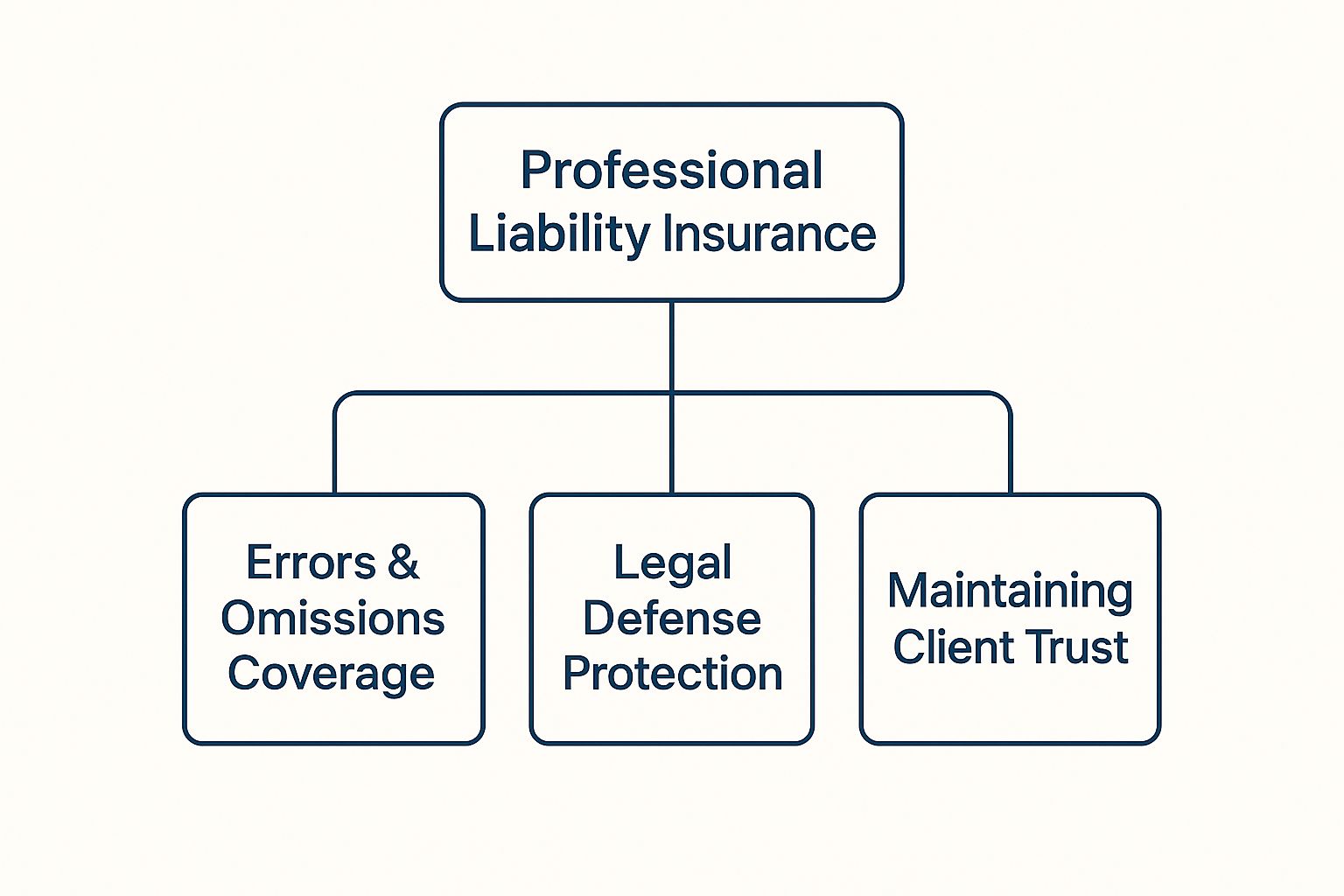
As you can see, the goal is to ensure one alleged mistake doesn't have the power to derail your entire business.
Why This Insurance Is a Non-Negotiable Asset

If you're in a service-based business, your expertise is your product. But what happens when that expertise gets called into question? The reality is that any client can claim your work, advice, or even a simple oversight caused them a financial loss.
That's when professional liability insurance shifts from a "nice-to-have" to a core part of your business's survival kit. Without it, you're flying solo, leaving both your business and personal assets exposed. A single lawsuit—even one that's completely baseless—can force you to drain your accounts to cover lawyers, court costs, and potential settlements.
Think of this coverage as a financial firewall. It stands between a legal claim and your hard-earned assets, giving you the confidence to do your job without constantly looking over your shoulder.
More Than Just a Safety Net
Beyond just paying legal bills, this insurance is a powerful business tool. In fact, many corporate clients and government agencies won't even consider working with you unless you can show them a certificate of insurance. It's often a non-negotiable part of the contract.
Having professional liability insurance signals to clients that you are a responsible, stable partner who is prepared for unforeseen issues. It demonstrates a commitment to accountability and can be the deciding factor that helps you win a project over a less-prepared competitor.
In short, the policy becomes a part of your professional reputation. It tells the world you’ve planned for contingencies and are serious about protecting both your business and your clients' interests. While you protect your assets from lawsuits, you should also consider protecting your income stream if you're unable to work; our guide on disability insurance for business owners explains how.
A Response to a More Litigious World
The need for this protection isn't just a hypothetical. We live and work in an increasingly complex and litigious environment, where client expectations are high and disputes are more common.
The market numbers back this up. The global professional liability insurance market was valued at USD 44.96 billion and is projected to climb to USD 60.91 billion by 2033. This growth isn't random; it's a direct response to the rising legal risks professionals face every single day.
This trend highlights a critical point: your peers and competitors are arming themselves with this coverage. Operating without it means you're taking a gamble that others in your field are wisely avoiding, leaving your business vulnerable in a world where legal challenges are just part of the cost of doing business.
What Professional liability Insurance Actually Covers

So, what does this policy actually do for you in the real world? Let’s get past the jargon and look at the specific claims it's built to handle.
Think of professional liability insurance as a financial shield against three main types of professional missteps. Each one is a different flavor of a client claiming your work, advice, or service caused them a financial loss.
First up is professional negligence. This is the classic "you didn't do your job right" claim. It happens when you fail to meet the accepted standard of care in your field, and a client loses money because of it. A perfect example is an accountant who misses a crucial tax deadline, forcing their client to pay thousands in penalties.
Next, you have errors and omissions. This is a bit broader, covering mistakes you made or things you simply forgot to do. Imagine a web developer who accidentally leaves a security hole in a client’s e-commerce site. If that site gets hacked and sales are lost, that's a classic errors and omissions claim.
Finally, there's misrepresentation. This happens if a client believes you gave them bad information or misleading advice that led to a terrible business decision. For instance, a consultant who wildly overstates the potential return on an investment, convincing a client to sink money into a project that flops, could get sued for misrepresentation.
What Your Policy Typically Covers
When one of these claims lands on your desk, your professional liability insurance springs into action. It’s designed to cover the staggering costs that come with defending your business—costs that can easily sink a small company.
Here’s what your coverage is designed to pay for:
- Legal Defense Costs: This is the big one. It includes attorney fees, court costs, and all the other legal bills, whether you’re found at fault or not.
- Settlements and Judgments: If you’re found liable or just decide to settle the case to make it go away, the policy pays the amount up to your coverage limit.
- Expert Witness Fees: Defending your work often means hiring specialists in your field to testify that you met professional standards. Your policy can cover their fees.
- Claims of Slander or Libel: If a client argues your professional work damaged their reputation, this can also fall under your coverage.
These protections ensure that a single client dispute doesn't have the power to wipe out your company’s bank account.
Common Exclusions to Understand
Just as important as knowing what’s covered is knowing what isn’t. This insurance is highly specific and won’t act as a catch-all for every business risk you face.
Policies are built to cover unintentional mistakes—not deliberate wrongdoing or physical accidents. Knowing where your coverage ends is the key to managing your total business risk.
Here are a few common exclusions:
- Intentional Acts: Fraud, criminal acts, or anything you did on purpose is never covered. Insurance is for accidents, not for bad behavior.
- Bodily Injury or Property Damage: If someone trips in your office or you damage a client’s server, that’s a job for a different policy. You can learn more about how general liability insurance matters for Florida businesses to handle these physical risks.
- Employment Disputes: Claims from your own employees, like wrongful termination or discrimination, require a separate policy called Employment Practices Liability Insurance (EPLI).
- False Advertising: If you knowingly make false claims in your advertising to win business, that’s generally not covered.
Who Absolutely Needs This Coverage?
While just about any service-based business can sleep better at night with professional liability insurance, for some pros, it’s not just a good idea—it’s non-negotiable. If your work hinges on specialized knowledge, advice, or services that could cost a client a fortune if things go sideways, you’re in the hot seat.
Think of it like this: a baker who sells a bad batch of cookies might have to offer a refund. An accountant who botches a tax filing, however, could leave a client facing tens of thousands of dollars in IRS penalties. That massive difference in potential financial fallout is what separates a simple customer service hiccup from a professional liability lawsuit.
For these professionals, the risk isn't some far-off "what if." It's baked into the business model, where a single oversight can trigger a devastating legal battle.
High-Stakes Professions and Real-World Risks
Certain industries just carry a much heavier burden of professional risk. For people in these roles, skipping coverage is a massive gamble. Clients are not only more likely to sue, but the damages can be astronomical. In fact, many clients won't even sign a contract unless you can show them proof of insurance.
Here are a few classic examples of professionals on the front lines of liability risk:
- Consultants and Accountants: A business consultant advises a company to enter a new market that tanks, leading to huge losses. The client sues, claiming the consultant’s market analysis was negligent.
- IT Professionals and Developers: A software developer’s code has a subtle bug that crashes their client's e-commerce site during Black Friday. The client sues for lost revenue and the cost of emergency repairs.
- Architects and Engineers: An architect’s design plans contain a measurement error, forcing costly construction delays and modifications. The property developer sues to recover every last dime of those extra expenses.
- Marketing Agencies: A marketing firm launches a campaign that accidentally infringes on another company's trademark. The client gets hit with a lawsuit and immediately turns around and sues the marketing agency to cover their legal fees and damages.
The Ultimate Example: The Medical Field
Nowhere is this risk more obvious than in medicine. Within the world of professional liability, a specialized policy called medical professional liability insurance (MPLI) is seeing explosive growth. The global MPLI market, valued at around $12.5 billion in 2021, is projected to balloon to $33.7 billion by 2031, thanks in large part to a rise in malpractice litigation.
For doctors, surgeons, and other healthcare providers, this coverage isn't just a contractual requirement—it’s a career lifeline. A single malpractice claim can jeopardize their license, reputation, and entire financial future.
This drives home a key point: the higher the stakes of your professional advice or service, the more critical this insurance becomes. And while this policy is all about protecting you from financial errors, don't forget that protecting your team from physical injuries at work is just as vital. For that, check out our guide on workers' compensation in Florida for employers to understand those separate but equally important responsibilities.
Understanding the Cost of Your Policy

One of the first questions on every professional's mind is, "So, what's this actually going to cost me?" The answer isn't a simple, flat rate. The price of professional liability insurance is a personalized calculation based on your unique risk profile.
Think of it like car insurance. A teenager with a brand-new sports car is going to pay a much higher premium than a seasoned driver with a safe, reliable sedan. The insurer isn't making a judgment call; they're simply calculating the statistical risk. Your professional liability premium works the same way—insurers weigh several key factors to figure out the likelihood and potential cost of a claim against you.
Each piece of information helps build a clear picture of your business's specific liability exposure.
Key Factors That Shape Your Premium
Your final cost is really a blend of variables that reflect your industry, your business's size, and your track record. Insurers look closely at these elements to come up with a premium that accurately matches your risk level.
Here are the most influential factors:
- Your Profession: The single biggest driver of your cost is what you do for a living. An architect, whose mistake could lead to millions in construction rework, represents a much higher risk than a freelance writer. High-stakes professions simply come with higher premiums.
- Coverage Limits and Deductible: This one is straightforward: how much protection do you need? A policy with a $2 million coverage limit will naturally cost more than one with a $500,000 limit. On the flip side, choosing a higher deductible (the amount you pay out-of-pocket before insurance kicks in) can lower your monthly premium.
- Your Claims History: Just like with car insurance, a clean record really pays off. If you’ve never had a claim filed against you, you'll be seen as a lower risk and will almost certainly pay less than a business with a history of lawsuits.
These elements create a baseline for your premium, but a few other details also play a big part.
Business Size and Location Matter
Your company’s scale and where you operate have a direct impact on your insurance costs. A larger business with higher annual revenue generally has more at stake and interacts with more clients, which naturally increases the potential for a claim. It makes sense, then, that a firm earning $5 million a year will pay more for coverage than a solo practitioner making $80,000.
Your location is another critical piece of the puzzle. Some states or regions are known for being more litigious, meaning lawsuits are just more common and jury awards tend to be higher. This regional risk is factored directly into your premium.
The liability insurance market in North America is the largest in the world, valued at USD 134.26 billion, with the U.S. alone accounting for about USD 107.40 billion. Rates in the U.S. have been climbing because of the increasing frequency and severity of claims, making your location a key determinant of what you'll end up paying. You can dig into more of the data on these global insurance market trends on precedenceresearch.com.
How to Choose the Right Liability Policy
Finding the right professional liability policy isn't nearly as complicated as it sounds. It just takes a methodical approach. Forget the jargon for a minute—the whole process starts by thinking critically about your own business.
First up, you need to assess your unique risks. What’s the absolute worst that could happen to a client if you make a mistake? For an IT consultant, a single error could trigger a data breach costing a client millions. For a graphic designer, a mistake might mean a much smaller loss on a botched printing run. Make a list of your biggest potential liabilities. This exercise helps you nail down a realistic coverage limit.
Next, get your paperwork in order. Insurers will want to see the basics: annual revenue, number of employees, how long you've been in business, and any past claims. Having this ready to go makes the application process ten times smoother.
Comparing Your Options and Understanding the Details
Once you've got your info together, it's time to compare quotes from multiple carriers. This is a non-negotiable step. Never, ever take the first offer you get. Prices and coverage details can be wildly different from one insurer to the next, so getting at least three quotes is just smart business. An independent insurance broker can be a huge help here, since they can shop the market for you.
As you look at the quotes, you'll notice one huge distinction: is it a claims-made or an occurrence policy?
- Claims-Made Policy: This is the most common type you'll see. It covers claims that are filed while your policy is active, no matter when the work was actually done. The catch? If you cancel this policy, you’ll likely need to buy extra "tail coverage" to protect yourself from claims related to past work.
- Occurrence Policy: This one covers incidents that happen during the policy period, even if the claim is filed years down the road. It’s less common for professional liability, but it offers more straightforward, long-term peace of mind.
The difference between claims-made and occurrence policies is critical. Getting it wrong can accidentally create huge gaps in your coverage, especially if you ever switch insurers or decide to retire.
Finally, read the fine print. No, really. Pay special attention to the policy exclusions so you know exactly what isn't covered. By taking these deliberate steps, you can lock in a policy that actually protects the business you've worked so hard to build.
Your Top Questions Answered
When you're digging into professional liability insurance, a few key questions always pop up. Let's get you some straight answers.
Is Professional Liability Insurance Tax-Deductible?
Yes, it usually is. Since this insurance is a standard cost of running your business, the premiums you pay are generally considered a tax-deductible business expense.
Of course, every business's financial picture is different. It's always a smart move to chat with your tax advisor to confirm how this applies to you.
What is a Claims-Made Policy?
This is the most common type of policy you'll run into, and the name says it all. A claims-made policy covers you for claims that are filed while your policy is active.
It's a simple but crucial detail. If you cancel your policy and a former client sues you six months later for work you did last year, you wouldn't be covered—unless you bought an extension called "tail coverage."
How Much Coverage Do I Actually Need?
There's no single magic number; the right amount depends on your industry, the clients you work with, and your overall risk. The best way to start is by thinking about the absolute worst-case financial damage a client could face because of a mistake you made.
Many client contracts take the guesswork out of it and will spell out a minimum coverage amount, often starting at $1 million per occurrence.
Check your contracts first. Then, weigh that against the potential cost of a lawsuit to land on a policy limit that lets you sleep at night, knowing your business is protected from a devastating financial hit.
Finding the right liability coverage can feel complicated, but it doesn't have to be. Let the experts at MyEasyRate Insurance help you find a policy that fits your professional needs and budget. Get your free, no-obligation quote today at https://myeasyrate.com.


