

If you're a Florida homeowner, you already know the sticker shock is real. The average cost for hurricane insurance has climbed to an eye-watering $5,376 per year for a standard policy.
But that's just a starting point. Your final number can swing wildly based on where you live, your home's value, and how it was built. Let's break down what's really driving these costs.
The Real Cost of Hurricane Insurance in Florida
Trying to figure out how much hurricane insurance is in Florida means you have to understand our unique market. In most other states, windstorm protection is just baked into a standard homeowners policy. Not here.
In Florida, hurricane coverage is often its own beast with a separate—and usually substantial—deductible. This isn't just to make things complicated; it's a direct response to the state's massive exposure to tropical storms.
The financial reality has been a rollercoaster. As of 2025, the average premium for a home insured for $300,000 is sitting at around $5,376. That's a staggering 34% jump since late 2022 and is roughly 146% higher than the national average premium of $2,181.
To give that some context, we've created a quick snapshot of the numbers.
Florida Hurricane Insurance Costs at a Glance
This table breaks down the average premiums, showing just how much more Florida residents pay compared to the rest of the country.
| Metric | Average Annual Cost | Key Details |
|---|---|---|
| Florida Hurricane Insurance Premium | $5,376 | For a home with $300,000 dwelling coverage in 2025. |
| National Average Homeowners Premium | $2,181 | Represents a baseline cost for typical risks nationwide. |
| Florida's Increase Since Late 2022 | +34% | Highlights the recent, rapid inflation in the state's market. |
As you can see, the "sunshine tax" is very real when it comes to protecting your home.
Why Is It So Much Higher Than the National Average?
Think of the national average as the price to protect a home from common risks like fire, theft, or a burst pipe. For Floridians, the ever-present threat of a hurricane adds a massive surcharge right on top.
This huge gap shows why preparing for a storm in Florida is as much a financial drill as it is a physical one. If you want to see the bigger picture, you can take a look at the average cost of homeowners insurance nationwide to see just how much of an outlier our state has become.
This steep price isn't random. Insurers use complex models to calculate the potential for catastrophic losses from a single major storm. With its long, exposed coastline, Florida is always at the top of that high-risk list.
Key Takeaway: The high cost of hurricane insurance in Florida isn't just an expense—it's a direct calculation of the immense risk that insurers take on in a state that's a magnet for major storms.
What Does This Average Cost Actually Cover?
It's crucial to know what you're getting for that $5,376 figure. A standard policy with hurricane coverage is designed to pay for repairs or a full rebuild if your home's structure is damaged by wind or wind-driven rain.
However, a few critical things are almost always excluded:
- Flood Damage: This is the big one. Damage from storm surge or rising waters requires a completely separate flood insurance policy.
- Personal Belongings: Your policy might have different (and lower) limits for your furniture, electronics, and other contents.
- Additional Living Expenses: This helps cover hotel bills and other costs if you're forced out of your home, but the coverage has limits.
The average premium is just a benchmark. Your actual quote will hinge on a whole host of factors specific to your property, which we'll dive into next.
Why Florida Hurricane Premiums Are So High
If you've ever felt like figuring out Florida's hurricane insurance costs is like solving a puzzle with missing pieces, you're not alone. It’s not just one thing driving up your bill. It's a perfect storm of environmental risk, global economics, and local market pressures that have created today’s tough situation.
At its core, the sky-high price is a direct reflection of immense risk. Think of the insurance market as a massive savings account for the whole state. When a major hurricane hits, the withdrawals are huge—often tens of billions of dollars from a single storm.
To keep that account from going broke, insurers have to collect enough in premiums to cover those potential losses. As the risk of a catastrophic storm grows, so does the amount they need to collect from every homeowner. This is the fundamental reason why Florida homeowners need hurricane insurance, but it’s also what makes it so expensive.
The Ripple Effect of Reinsurance
Your local insurance company doesn't actually shoulder all that risk on its own. They have their own insurance policy, which they buy from giant global companies called reinsurers. This reinsurance is a critical safety net that stops local insurers from going bankrupt after a disaster.
But that safety net comes at a steep price. Reinsurers set their rates based on global disasters—not just Florida's weather. So when wildfires rage in California or floods devastate Europe, the cost of reinsurance goes up for everyone, including Florida carriers.
When global reinsurance costs jump by 30-50%, your local insurer has no choice but to pass that increase directly on to you. It’s one of the biggest, and least visible, drivers of your annual premium hike.
On top of reinsurance, other factors like inflation, market volatility, and, until recently, a chaotic legal environment have all pushed premiums higher. Widespread lawsuits and roofing scams inflated claims payouts for years, forcing insurers to raise rates to stay afloat.
A Shrinking Pool of Insurers
Another huge piece of the puzzle is simple supply and demand. Over the last few years, many insurance companies have either failed or just packed up and left Florida, deciding the risk was too high for too little reward.
This mass exodus hits your wallet in two key ways:
- Less Competition: With fewer companies writing policies, there's no real pressure to keep prices down. The insurers who remain can charge more because homeowners have nowhere else to go.
- Concentrated Risk: The few companies left are now on the hook for a bigger slice of Florida's $3 trillion in insured property. Spreading that massive risk among fewer players means each one has to charge higher premiums to protect themselves.
This shrinking market leaves a handful of companies to carry an ever-growing financial burden. The result is a cycle of rising rates and fewer options, turning the hunt for affordable coverage into a major challenge for millions of Floridians.
Key Factors That Determine Your Premium
So, what’s the secret sauce that goes into your final premium? While big-picture market trends set the stage, the quote you get is intensely personal. Insurers put your property under a microscope, analyzing a whole slew of variables to figure out your unique risk profile.
Think of it as a risk score for your house. Certain features earn you points and bring down your cost, while others raise red flags and send your premium climbing. Getting a handle on these factors is the first step to taking control of your insurance bill.
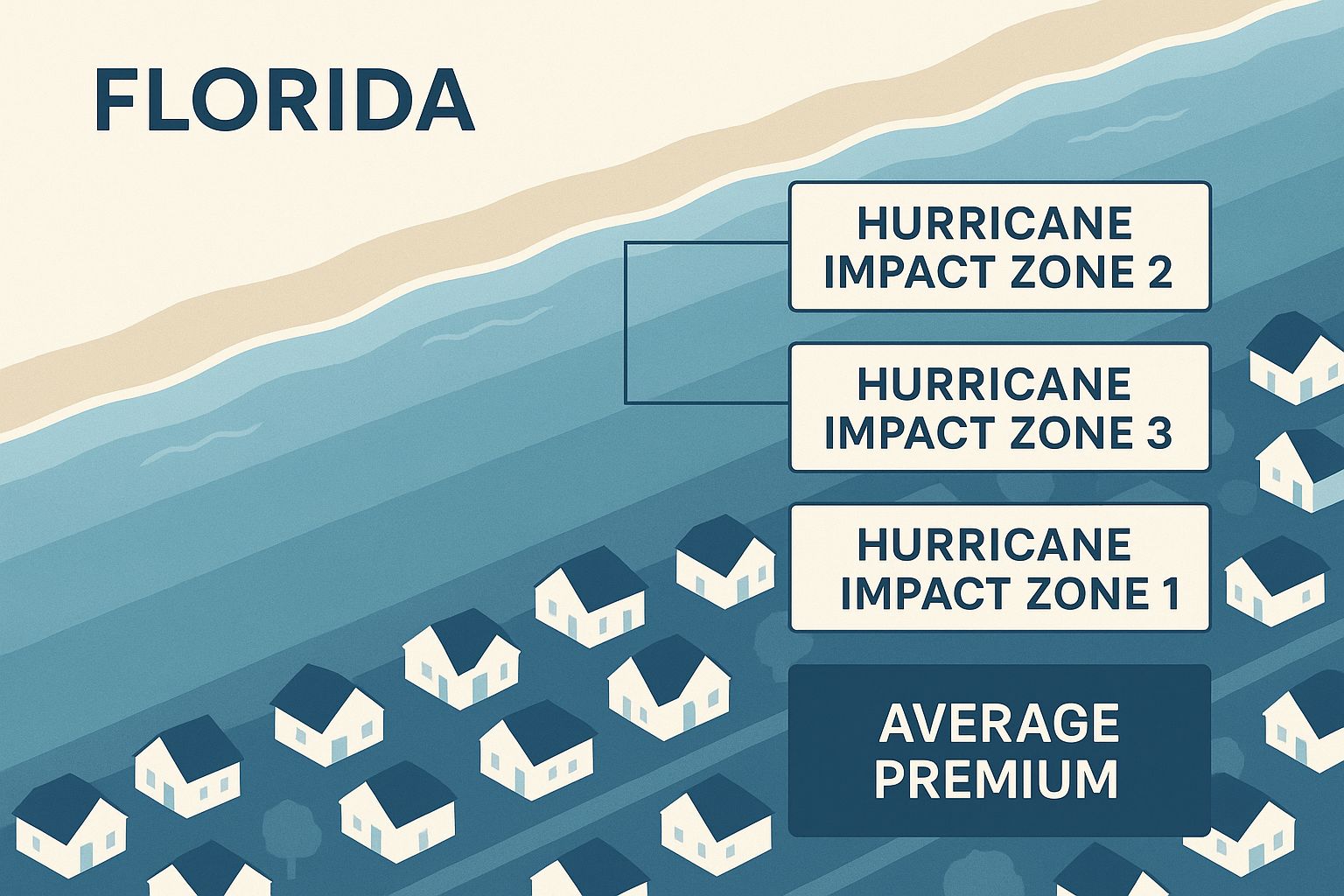
As you can see, things like how close you are to the water and the integrity of your roof are front-and-center in an insurer's calculations. Let's break down what matters most, one piece at a time.
Your Home's Location and Construction
Location is everything. It's easily the most significant factor in your premium. Insurance companies use sophisticated mapping tools to pinpoint exactly how vulnerable your home is to storm surge and hurricane-force winds. A house in a high-velocity wind zone or a low-lying coastal area is simply going to cost more to insure. No way around it.
What your home is made of is a close second. A concrete block (CBS) home stands up to wind far better than a wood-frame structure, a fact that's reflected in lower insurance costs. The year your home was built is also critical, since newer building codes require much stronger, more storm-resistant construction.
The Age and Shape of Your Roof
Your roof is your home’s shield against a hurricane, and you can bet insurers inspect it with a fine-toothed comb. A newer roof, especially one installed after the big 2002 Florida Building Code updates, is a huge plus and can lead to some serious discounts. On the flip side, a roof that's over 15 years old can be a major roadblock to getting affordable coverage at all.
The shape of your roof is just as important. A hip roof, which slopes down on all four sides like a pyramid, is much more aerodynamic. It performs significantly better in high winds compared to a standard gable roof (the classic A-frame shape), and insurers reward that stability.
To put it in perspective, a homeowner with a 5-year-old hip roof on a concrete block house might pay 20-30% less for hurricane insurance than their neighbor with a 20-year-old gable roof on a wood-frame house—even if the homes are right next door to each other.
This table gives you a quick snapshot of how these features can swing your rates.
How Home Features Impact Your Insurance Rate
| Home Feature | Lower Premium Option | Higher Premium Option | Estimated Impact |
|---|---|---|---|
| Construction | Concrete Block (CBS) | Wood Frame | 15-25% difference |
| Roof Shape | Hip Roof (4 slopes) | Gable Roof (2 slopes) | 10-20% difference |
| Roof Age | Under 10 years old | Over 15 years old | 10-30% difference |
| Opening Protection | Hurricane Shutters / Impact Glass | No Protection | 20-40% difference |
This shows just how much control you have. The final piece of the puzzle is having documented wind mitigation features. Things like hurricane shutters, impact-resistant windows, and reinforced garage doors can unlock some of the biggest discounts available, directly lowering your premium.
Understanding Your Hurricane Deductible

When you're trying to figure out how much hurricane insurance costs in Florida, the yearly premium is only half the story. The other critical piece of the puzzle is your hurricane deductible, and it's easily one of the most misunderstood parts of any home policy.
This isn't your typical flat-rate deductible, like the $500 you might pay for a car repair. Instead, a hurricane deductible is almost always a percentage of your home's total insured value.
That small difference has massive financial consequences. It means the amount you're on the hook for isn't tied to the cost of the repairs—it's tied to the total value of your home.
How Percentage-Based Deductibles Work
Let's walk through a real-world example to see exactly how this plays out.
Imagine your home is insured for $400,000. You check your policy declarations page and see you have a 5% hurricane deductible.
The math is simple but sobering:
- Home's Insured Value: $400,000
- Hurricane Deductible Percentage: 5%
- Your Out-of-Pocket Cost: $400,000 x 0.05 = $20,000
This means you must pay the first $20,000 for damages from a named hurricane before your insurance company contributes a single dollar. If a storm rips through and causes $50,000 in damage, you pay your $20,000, and your insurer covers the remaining $30,000.
A hurricane deductible only kicks in for damage caused by a named storm. For other problems, like a kitchen fire or a burst pipe, you’d pay your standard, much lower "all-peril" deductible.
The Trade-Off: Lower Premiums vs. Higher Risk
So, why would anyone voluntarily sign up for such a high deductible? It all comes down to a direct trade-off with your annual premium. In Florida, you can typically choose a hurricane deductible ranging from 2% to 10%.
The rule is straightforward:
- Higher Deductible = Lower Annual Premium: When you agree to take on more of the initial financial risk, the insurance company rewards you with a lower yearly bill.
- Lower Deductible = Higher Annual Premium: When you shift more of the potential risk onto the insurer, they charge you more to cover their increased exposure.
Choosing the right percentage is a personal financial decision. You have to weigh the immediate savings on your premium against the potential out-of-pocket hit if a hurricane strikes. A higher deductible might save you hundreds each year, but you absolutely must be prepared to cover a five-figure expense on very short notice.
How to Lower Your Hurricane Insurance Costs
Feeling sticker shock from Florida hurricane insurance premiums is normal, but you're not stuck. You have more power than you think to bring those numbers down. It really boils down to making your home a less risky bet for an insurance company—and then proving you've done it.
The single most effective strategy is wind mitigation. Think of it as putting armor on your house before the storm hits. Every upgrade you make to strengthen your home against wind damage makes it less likely to suffer a catastrophic failure. Insurers love that, and they'll reward you for it.
These improvements aren't just for peace of mind; they're your ticket to some of the biggest discounts on your policy.
Fortify Your Home for Maximum Savings
During a hurricane, your home's weakest links are its openings: the windows, doors, and especially the garage door. Beefing up these spots can lead to some serious premium reductions.
Focus on these high-impact upgrades:
- Hurricane Shutters or Impact-Resistant Windows: If you want serious discounts, protecting your windows is a must. Impact glass offers round-the-clock, passive protection. Shutters are a more hands-on, budget-friendly option that's just as effective.
- Reinforced Garage Doors: A standard garage door is like a giant sail. Under hurricane-force winds, it can buckle and fail, creating a domino effect that can rip the roof right off your house. A wind-rated garage door is a non-negotiable upgrade.
- Stronger Roof-to-Wall Connections: This is a foundational part of wind mitigation. Using special metal connectors called hurricane clips or straps to anchor your roof trusses to the walls makes your home exponentially stronger.
Once the work is done, you absolutely must get a wind mitigation inspection. A certified inspector comes to your home, documents all its protective features, and fills out a standardized report. This report is your golden ticket. It's the official proof you hand over to your insurance company to unlock discounts that can slash your premium by up to 40% or more.
Don't just do the work—get the inspection report. Without that official piece of paper, your insurer won't apply the credits you've earned. You'll be leaving hundreds, maybe even thousands, of dollars on the table every year.
Fine-Tune Your Policy and Financial Health
Beyond physical home improvements, a few strategic tweaks to your policy and finances can also chip away at your premium.
One of the fastest ways to see a lower bill is to raise your hurricane deductible. As we covered earlier, bumping your deductible from 2% to 5% means you agree to cover more of the initial repair costs yourself. In exchange, the insurance company will give you a lower annual premium. Just be honest with yourself—can you comfortably write a check for that higher amount if a storm hits?
Bundling your policies is another powerful, and often easy, move. If your auto insurance is with one company and your home policy is with another, you're almost certainly missing out. Combining them with a single carrier can often knock 10-20% off the total bill.
Finally, don't ignore your credit score. Florida insurers use a credit-based insurance score as one factor in setting your rates. A better score suggests financial responsibility, which often translates to a lower premium.
Always Shop Around for the Best Rate
This might be the most important action you can take. You have to compare quotes from multiple insurance companies. Rates for the exact same house and the exact same coverage can vary wildly from one carrier to the next. Never, ever assume your current insurer is giving you the best deal.
Make it a habit to get quotes from at least three different companies every single year before you renew. If you find a better price, don't be afraid to make a move. For a step-by-step walkthrough, check out our guide on how to switch insurance companies to make sure you do it right, without any dangerous gaps in coverage.
Taking an hour to shop around could literally save you a small fortune.
So, you’ve done everything by the book. You hardened your home, shopped around until you were blue in the face, and your credit is solid. But the quotes for hurricane insurance are still astronomical. What now?
For a growing number of Floridians, this isn't a hypothetical. The private insurance market is simply locking them out. When that happens, you’re not out of options, but you do enter a different world of coverage—one built as a safety net when the traditional market fails.
This is where many homeowners are forced to turn to the state's "insurer of last resort" or look at newer, less conventional products. Understanding these alternatives is the key to solving the insurance puzzle when standard policies are out of reach. They offer vital protection, but they come with their own set of rules.
Citizens: The State's Insurer of Last Resort
The most common alternative you'll hear about is Citizens Property Insurance Corporation. Created by the Florida Legislature, Citizens is a government entity that provides coverage to homeowners who genuinely can't find an affordable policy in the private market. Think of it as the public option for home insurance.
To get a Citizens policy, you generally have to prove you were either denied coverage by private insurers or that the quotes you received were more than 20% higher than what Citizens can offer you. While it’s a crucial backstop, be aware that its policies are often less comprehensive and can have stricter coverage limits than what you'd find on the private market.
The goal of Citizens isn't to compete with private insurance companies. It’s there to keep the market stable. The long-term plan is for Citizens to shrink as the private market heals, moving homeowners back to private policies.
Parametric Insurance: A Completely Different Approach
Beyond the state-run option, a new type of solution called parametric insurance is getting a lot more attention. It works very differently. Instead of paying you based on the actual damage to your home, a parametric policy pays a pre-agreed, fixed amount when a specific event trigger is met.
For example, a policy might be set up to pay out $25,000 if a Category 3 hurricane with sustained wind speeds of 115 mph is officially recorded at your address. The trigger is pure data from a source like the National Hurricane Center—not a damage assessment.
The big advantage here is speed. Because no claims adjuster needs to visit your property, the payout is fast and direct. But there's a catch: that fixed payout might not be enough to cover all your repairs. This reality highlights a grim statistic: nearly one in five Florida homeowners have no property insurance at all because of the cost. As traditional insurers pull back, these new models are becoming more important than ever.
You can learn more about how these innovative insurance products are evolving by checking out this full analysis on emerging risk management strategies.
Common Questions, Answered
When it comes to hurricane coverage, a lot of questions pop up. Let's clear up some of the most common ones Florida homeowners ask.
Is Hurricane Insurance Required by Law in Florida?
Straight answer: no, the state of Florida doesn't legally force you to have hurricane insurance.
But here’s the reality for most homeowners: if you have a mortgage, your lender will absolutely require it. They have a massive financial stake in your property, and they need to make sure that investment is protected from being wiped out by a storm.
If you own your home free and clear, the decision is entirely up to you. Just know that going without coverage means you are on the hook for 100% of the repair and rebuilding costs. After a major storm, that can easily climb into the tens or even hundreds of thousands of dollars out of your own pocket.
Does My Hurricane Insurance Also Cover Flooding?
This is a critical point that trips up so many people: no, it does not. Your standard homeowners policy, hurricane endorsement included, specifically excludes damage from flooding and storm surge. Insurers define flood damage as water rising from the ground up.
To be truly protected, you need a separate flood insurance policy. Most Floridians get one through the National Flood Insurance Program (NFIP), although some private insurers are starting to offer their own versions. For complete peace of mind in Florida, you really need both policies.
Here's a classic mistake to avoid: assuming wind-driven rain is the same as flooding. Rain that gets in because a hurricane damaged your roof or blew out a window? That’s typically covered by your hurricane policy. Water that seeps in from the ground as a storm surge rises? That’s flooding, and it’s not.
What Should I Do First After a Hurricane Damages My Home?
Your number one priority is always safety. Once you and your family are out of harm's way and the storm has passed, it's time to shift into documentation mode.
- Photos and Videos Are Your Best Friend: Before you touch, move, or clean up a single thing, take pictures and videos of everything. The more detailed, the better.
- Stop the Bleeding: Make reasonable temporary repairs to prevent more damage. Think putting a tarp over a hole in the roof or boarding up a broken window.
- Keep Every Receipt: Hold onto the receipts for any materials you buy for these quick fixes, like tarps, plywood, or tape. Your insurer will likely reimburse you for these costs.
Once you have that initial evidence locked down, call your insurance company as soon as you can to start the claims process. They’ll walk you through the next steps and get an adjuster assigned to your case.
At MyEasyRate Insurance, our job is to help you find that sweet spot between solid coverage and a price that fits your budget. We can give you a clear, no-obligation quote so you can see exactly how to prepare for storm season. Learn more at https://myeasyrate.com.


