

When you're self-employed, figuring out health insurance can feel like a chore. But it’s simpler than you might think. Your main roads to coverage are usually ACA Marketplace plans (which often come with discounts), private plans bought straight from an insurer, health sharing ministries, or short-term policies for temporary gaps.
Getting a handle on these paths is the first step. It's how you'll find coverage that protects both your health and your bottom line.
Why Your Health Insurance Strategy Matters
Let's be honest: when you're your own boss, you are the company's most important asset. There’s no HR department handing you a benefits package. The responsibility to get covered lands squarely on you.
This isn't just about managing risk—it's a core business decision. It directly impacts your financial stability and your peace of mind. For a lot of entrepreneurs and freelancers, making that jump from a company plan is a big one. If you're in that boat, our guide on health coverage after job loss in Florida breaks down how to handle that transition.
The market for private health coverage is huge and getting bigger. The global private health insurance market was valued at USD 1.2 trillion in 2023 and is on track to more than double to USD 2.4 trillion by 2032. That growth shows just how many people—including a ton of self-employed pros—are actively buying their own plans. You can discover more about this market trend and see what's driving it.
Breaking Down Your Main Options
Navigating health insurance plans for the self-employed means knowing the good and bad of each option. There’s no single "best" choice; it really comes down to your income, health needs, and how much risk you're comfortable with.
Let's simplify it. Here are the main routes you can take:
- Affordable Care Act (ACA) Marketplace: This is the starting point for many. It offers solid, comprehensive plans and, most importantly, access to income-based subsidies that can slash your monthly premiums.
- Private Off-Exchange Plans: These are policies you buy directly from an insurance company. They might have different doctor networks or benefits you can't find on the Marketplace, but you can't use premium tax credits to pay for them.
- Health Sharing Ministries: These are faith-based groups where members pool money to cover medical bills. They aren't traditional insurance and often have strict rules about what they’ll cover, especially pre-existing conditions.
- Short-Term Health Insurance: Think of these as a temporary patch. They offer limited coverage for a set amount of time. They're cheaper but don't cover the essentials and won't protect you from major medical debt.
Choosing the right plan isn't an expense; it's an investment in your business's future. A sudden medical emergency shouldn't be able to derail the company you've worked so hard to build.
To give you a clearer picture, I've put together a table that gives you a quick, high-level comparison of your main options. It’s a great starting point for figuring out which path makes the most sense for your situation.
Comparing Your Health Coverage Options
| Coverage Option | Best For | Key Feature | Potential Drawback |
|---|---|---|---|
| ACA Marketplace | Individuals with variable or moderate incomes needing comprehensive coverage. | Eligibility for premium tax credits (subsidies) and cost-sharing reductions. | Network limitations and potentially higher premiums without subsidies. |
| Private Plans | Those who don't qualify for subsidies but want broader network choices. | Access to different plans and provider networks than those on the ACA exchange. | No access to government subsidies, making it a more expensive option. |
| Health Sharing | Healthy individuals aligned with the ministry's values seeking lower monthly costs. | Lower monthly contribution amounts compared to traditional insurance. | Not legally considered insurance; no guarantee of payment for medical bills. |
| Short-Term Plans | People needing temporary coverage between jobs or outside of open enrollment. | Low premiums and quick approval process for immediate, basic coverage. | Does not cover pre-existing conditions or essential health benefits. |
Each of these avenues serves a different purpose. The key is to match your personal and business needs—like your budget, health status, and preferred doctors—to the right type of plan.
Understanding Your Core Plan Options
When you start shopping for health insurance on your own, you’ll run headfirst into a wall of acronyms: HMO, PPO, EPO, POS. Don't get lost in the jargon. Just think of them like different types of cell phone plans. Each one gives you a different mix of network freedom, cost, and rules for how you get service.
Figuring out these core plan types is your first critical step. It lets you immediately filter out plans that don't fit your life, so you can focus on the ones that actually make sense for your health needs and your budget. Get this right, and you'll avoid overpaying for flexibility you don't need or getting stuck in a restrictive plan that doesn't include your trusted doctor.
This visual breaks down the main plan categories available to self-employed professionals.
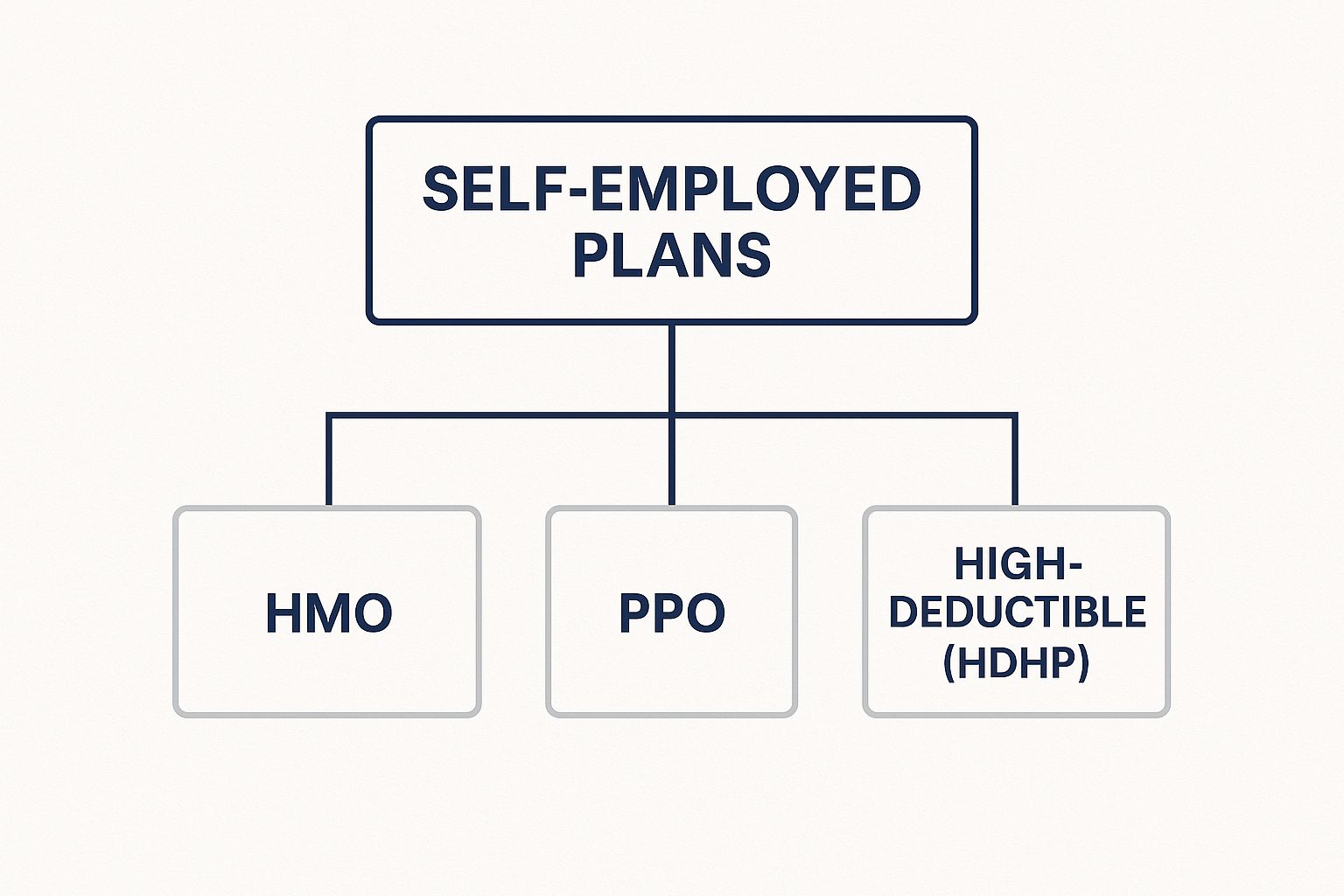
The diagram simplifies your choices into three primary buckets, helping you see the foundational structures from which most health plans are built.
HMO: Health Maintenance Organization
Think of a Health Maintenance Organization (HMO) as a curated, all-inclusive service. To get care, you must use the doctors, hospitals, and specialists within its specific network. These plans almost always require you to pick a Primary Care Physician (PCP) who becomes your quarterback for all things health-related.
Need to see a cardiologist or a dermatologist? You'll need a referral from your PCP first. This "gatekeeper" system is designed to coordinate your care and keep costs down, which often means you pay lower monthly premiums.
- Key Feature: Lower premiums and predictable costs.
- Main Rule: You must stay within the plan's network, except for true emergencies.
- Referrals: A referral from your PCP is pretty much always required to see a specialist.
An HMO is often a great fit if you're watching your budget and don't mind having your care managed through a single primary doctor.
PPO: Preferred Provider Organization
A Preferred Provider Organization (PPO) is the flexible, "have it your way" option. PPOs have a network of "preferred" providers, and you'll pay the least when you visit them. The defining feature, though, is the freedom to go out-of-network for care whenever you want, without a referral.
Of course, that flexibility comes at a price. PPO plans generally have higher monthly premiums and often have a separate, higher deductible for any out-of-network services. You're paying a premium for the choice to see any specialist you want, without needing to ask for permission first.
Choosing between an HMO and a PPO is a classic trade-off. An HMO prioritizes cost savings through a structured network, while a PPO prioritizes freedom and flexibility at a higher premium.
This plan type is ideal for entrepreneurs who travel a lot or want direct access to specialists without the extra step of getting a referral.
EPO and POS: The Hybrid Models
Between the strict HMO and the wide-open PPO are two hybrid options: Exclusive Provider Organizations (EPOs) and Point of Service (POS) plans. They cherry-pick features from both to offer a middle ground.
- EPO (Exclusive Provider Organization): An EPO is like an HMO, but with one huge difference—you usually don't need a referral to see an in-network specialist. Like an HMO, however, it offers no coverage for out-of-network care (except in emergencies). It's the direct access of a PPO mixed with the cost control of a closed network.
- POS (Point of Service): A POS plan is a true mix. Like an HMO, you'll choose a PCP and need referrals for specialists. But like a PPO, you have the option to go out-of-network for care, though you’ll pay a lot more for it.
These hybrid models can be the sweet spot for self-employed people who want more control than an HMO but don't need the massive out-of-network benefits (and higher cost) of a full PPO. Your decision really comes down to how much you value network choice versus how much you want to save on your monthly bill.
Using The Health Insurance Marketplace
For many self-employed professionals, the most logical place to start your hunt for health coverage is the Affordable Care Act (ACA) Marketplace. Think of it as a specialized online store built specifically for health insurance, bringing plans from different companies together in one spot.
More importantly, it's the only place you can get government financial assistance to knock down your monthly costs. You can’t get these subsidies by going directly to an insurance company.
The main front door for most states is the HealthCare.gov website.

This portal will tell you whether your state uses this federal platform or runs its own. Either way, it gets you to the right place to start comparing plans and filling out an application.
How Subsidies Lower Your Monthly Costs
The single biggest reason to use the Marketplace is to get your hands on premium tax credits, which most people just call subsidies. These are designed to make your monthly insurance payments affordable by capping them based on your estimated income for the year. For freelancers and business owners with income that goes up and down, this is a lifesaver.
How much you get is tied directly to your income—the lower your projected net income, the bigger your subsidy. This financial help can be paid directly to your insurance company each month, so you just pay the leftover amount. In fact, 9 out of 10 people who enroll through a marketplace get financial help.
Here's a real-world example:
A freelance graphic designer estimates her net income for the year will be $45,000. Based on that, the Marketplace says she’s eligible for a $350 per month premium tax credit. If she picks a plan that costs $500 per month, she will only have to pay $150. The government sends the other $350 directly to her insurer.
This system is perfect for entrepreneurs. If you have a slow quarter and have to revise your income estimate downward, you can just update your Marketplace application. Your subsidy will likely increase, lowering your monthly bill even more.
Decoding The Metal Tiers: Bronze, Silver, Gold, And Platinum
When you start shopping on the Marketplace, you’ll see plans grouped into four "metal tiers": Bronze, Silver, Gold, and Platinum. This has zero to do with the quality of care you get. It’s simply a shorthand for how you and your insurance plan split the costs.
It’s a bit like choosing car insurance. You can get a basic, high-deductible policy or a premium one that covers almost everything with little out-of-pocket hassle.
-
Bronze Plans: These are your baseline plans. They have the lowest monthly premiums but the highest out-of-pocket costs when you actually need care. This means you’ll have a high deductible to hit before the plan starts paying for much. Bronze is a solid choice if you're healthy, want protection from a worst-case medical disaster, and need to keep your monthly fixed costs as low as possible.
-
Silver Plans: This is the middle-of-the-road option, with moderate monthly premiums and moderate costs when you go to the doctor. The secret weapon of Silver plans is their eligibility for Cost-Sharing Reductions (CSRs). This is an extra subsidy for lower-income folks that slashes your deductible, copayments, and coinsurance. If you qualify for CSRs, a Silver plan almost always offers the best bang for your buck.
-
Gold Plans: These plans flip the script with high monthly premiums but low out-of-pocket costs. Your deductible will be much lower, meaning your insurance starts paying its share much sooner. This tier is great for someone who knows they'll use their insurance for regular doctor visits, prescriptions, or to manage an ongoing condition.
-
Platinum Plans: This is the top-shelf option. Platinum plans come with the highest monthly premiums but the absolute lowest deductibles and copays. You’re paying more each month for the peace of mind that comes with very low, predictable costs whenever you need medical care.
Once you get a handle on how subsidies can slash your premiums and how the metal tiers balance your monthly payment against your out-of-pocket costs, you’re ready to navigate the Marketplace like a pro. You can find a plan that truly protects both your health and your business finances.
Looking Beyond the Marketplace: Other Insurance Paths
While the ACA Marketplace on HealthCare.gov is the go-to starting point for most freelancers and small business owners, it’s not the only game in town. Think of it as the main highway for health coverage—reliable and well-traveled. But sometimes, a different route gets you where you need to go faster or with better scenery.
Exploring these alternative paths is smart. You might find different doctor networks, unique benefits, or even financial strategies that turn your health plan into a wealth-building tool. Let's map out a few of these key detours.
Private "Off-Exchange" Health Plans
One of the most straightforward alternatives is buying a plan "off-exchange," which just means you purchase it directly from an insurance company or through a broker like us. These plans are still legit—they have to cover the same essential health benefits as Marketplace plans, so you aren't sacrificing core coverage.
So, what's the catch? You can't use premium tax credits (subsidies) to lower your monthly bill. This makes off-exchange plans a solid choice for entrepreneurs whose income is too high to qualify for Marketplace help but who still want quality coverage. The main upside can be access to a wider or just different network of doctors and hospitals.
HSAs: The Ultimate Financial Tool for the Self-Employed
If you want to turn your health plan into a powerful financial asset, pairing a High-Deductible Health Plan (HDHP) with a Health Savings Account (HSA) is a game-changer. This isn't just an insurance plan; it's more like a supercharged, tax-advantaged investment account that you can use for healthcare.
An HSA gives you a triple tax benefit you literally can't find anywhere else:
- Tax-Deductible Contributions: Money you put into your HSA is deducted from your income, which lowers your tax bill for the year.
- Tax-Free Growth: The money in your HSA can be invested to grow over time, completely tax-free.
- Tax-Free Withdrawals: You can pull money out for qualified medical expenses—from prescriptions to dental work—without paying a penny in taxes.
An HSA isn't just a rainy-day fund for medical bills; it's a long-term investment vehicle for your health and retirement. The money is yours to keep forever, even if you switch health plans later.
This strategy is catching on. In fact, one 2023 report noted that from 2010 to 2023, the share of medium-sized firms offering self-insured plans, which are often paired with options like HSAs, grew from 25% to 32%. You can read the full research about this trend to see how businesses are shifting their health strategies.
HSA vs. Traditional Plan: A Financial Snapshot
To see how this plays out in real dollars, let's compare an HDHP with an HSA against a more traditional PPO plan. We'll use a hypothetical scenario to illustrate the financial impact.
| Feature | HSA with HDHP | Traditional PPO Plan |
|---|---|---|
| Monthly Premium | Lower (e.g., $350) | Higher (e.g., $550) |
| Annual Deductible | High (e.g., $5,000) | Lower (e.g., $1,500) |
| Max Out-of-Pocket | High (e.g., $7,500) | Lower (e.g., $6,000) |
| HSA Contribution | Up to $4,300 (self-only, 2025) | Not available |
| Tax Savings | Yes, on contributions, growth, & withdrawals | None |
| Best For | Healthy individuals, savvy savers, long-term investors | Those who expect regular medical care or prefer predictable costs |
As you can see, the HSA route offers significant tax advantages and lower premiums, but requires you to shoulder more of the upfront costs. The PPO offers more predictability but comes with a higher fixed cost and no long-term savings vehicle.
Short-Term Health Insurance: A Temporary Fix
Sometimes, you just need a temporary bridge. Short-term health insurance plans are designed to be exactly that—a stopgap for a few months while you're between more permanent options. Maybe you just left a W-2 job and are waiting for the next Open Enrollment, or you have a gap before another plan kicks in.
But it's critical to know their limitations. These plans are not ACA-compliant. That means they:
- Do not have to cover essential health benefits like maternity or mental health care.
- Can and will deny you coverage for pre-existing conditions.
- Often have strict coverage caps, leaving you dangerously exposed to catastrophic medical bills.
Think of short-term insurance like a spare tire. It's great for getting you a short distance in an emergency, but you wouldn’t want to drive cross-country on it. If you've recently left a full-time job, it's also worth seeing if you can keep your health insurance in Florida through COBRA, which provides much more comprehensive continuation coverage.
How to Choose the Right Plan for Your Business

Alright, you've seen the options. Now comes the hard part: making the final call. Choosing the right health insurance plan isn’t about finding some mythical "best" plan—it's about finding the one that actually fits your health, your wallet, and your business.
Think of it like building a personal healthcare profile. This means getting honest about your medical history, your budget, and how much financial risk you can stomach. Get this right, and your plan becomes a true asset, not just another bill to pay.
Assess Your Healthcare Needs
First things first: take a realistic look at how you use (or expect to use) medical care. Are you generally healthy, only swinging by the doctor for an annual check-up? Or are you managing a chronic condition that involves regular specialist visits and prescriptions?
Ask yourself these simple questions:
- Doctor Visits: How many times did you or your family see a doctor last year? Do you expect that to change?
- Prescriptions: Are you on any regular medications? If so, you need to dig into the drug formularies of any plan you consider to make sure they're covered without breaking the bank.
- Specialist Care: Do you need to see a cardiologist, therapist, or dermatologist? A plan with a wider network or one that doesn't demand referrals (like a PPO) might be non-negotiable for you.
Having these answers ready makes comparing plans so much easier. It lets you look past the sticker price and see the real value you're getting.
Calculate the Total Cost of Coverage
That monthly premium? It's just the tip of the iceberg. It's the fixed, predictable part, but it tells you almost nothing about what you'll actually spend over the year.
The cheapest premium almost never means the cheapest plan. A low-premium, high-deductible plan can cost you a fortune if you have one bad month.
To figure out the true cost, you need to look at three numbers together:
- Premium: What you pay every month, no matter what.
- Deductible: The amount you must pay out-of-pocket before your insurance company starts paying its share.
- Out-of-Pocket Maximum: This is your financial safety net. It’s the absolute most you will have to pay for covered care in a year. Once you hit this number, your insurance pays 100% of covered costs.
Your comfort with risk is huge here. If you could handle a surprise $6,000 bill without blinking, a lower-premium plan might be a smart way to save cash. But if that kind of expense would be a financial disaster, you're better off with a higher premium and a lower deductible for that peace of mind.
Consider Self-Insurance for Your Business
As your business grows, you might start looking at more advanced strategies. One of those is self-insurance, where your business pays for employee health claims directly instead of paying premiums to an insurance company. A 2024 analysis showed 63% of U.S. employees with employer plans are in self-insured models, and that number jumps to 79% at bigger companies. It gives you a lot more control over your healthcare spending. You can learn more about how self-funded employers are preparing for future healthcare trends.
At the end of the day, protecting your income is just as important as protecting your health. For a deeper look at that, our guide on disability insurance for business owners has crucial insights you don't want to miss.
Alright, you’ve done the hard part—you understand the difference between an HMO and a PPO, you’ve wrapped your head around HSAs, and you’re ready to actually get covered. This last leg of the journey isn’t about more research; it’s about action.
Think of it like a simple checklist. Following these steps can turn what feels like a mountain of paperwork into a totally manageable task.
Step 1: Get Your Documents in Order
Before you even think about filling out an application, pull your key information together. Trust me, having everything in one place beforehand saves a ton of headaches and prevents you from having to stop mid-application to hunt down a tax form.
- Proof of Income: This is the big one for calculating subsidies. Grab your recent profit and loss statements, 1099 forms, or even signed client contracts. Anything that helps you realistically project your net income for the upcoming year will work.
- Household Info: You'll need the Social Security numbers and birthdates for every single person in your household who needs to be on the plan.
- Last Year's Taxes: Keep your most recent tax return nearby. The Marketplace uses it to help verify your identity and income, which speeds things up considerably.
Step 2: Compare Your Finalists and Pick a Winner
At this point, you should have it narrowed down to two or three solid plans. Now’s the time to get granular and look beyond the monthly premium. You need to see the whole picture.
Dive into the details. Double-check that your must-have doctors are in-network and that any critical prescription drugs you take are on the plan’s formulary. A cheap plan isn't cheap if it doesn't cover what you actually need.
This is also the perfect time to call in a pro. A licensed insurance broker can look over your final choices, answer those tricky "what-if" questions, and help you enroll—all at no extra cost to you. Their experience can be a lifesaver in confirming you’ve truly found the best fit.
Pro Tip: Did you miss the annual Open Enrollment window? Don't panic. Check if you qualify for a Special Enrollment Period (SEP). Big life events like moving to a new state, getting married, or losing other health coverage can open up a 60-day window for you to get a new plan.
Step 3: Apply and Activate Your Coverage
Once you’ve made your final decision, it’s time to complete and submit the application. After you get approved, you’ll make your first premium payment, often called a "binder payment." This is the final step that officially activates your new health plan.
And that’s it! You've successfully navigated the system and locked in a critical asset for both your business and your personal well-being.
Got Questions? We’ve Got Answers.
When you’re self-employed, navigating the fine print of health insurance can feel like a job in itself. Let's tackle some of the most common questions freelancers and business owners run into.
What Happens if My Income Goes Up or Down?
Welcome to the club! A fluctuating income is the reality for most self-employed folks. The key is to keep the Health Insurance Marketplace in the loop.
If you land a big project or have a slow month, update your income estimate on HealthCare.gov right away. Reporting a drop in income could qualify you for a bigger premium tax credit, lowering your monthly payments on the spot. If your income goes up, adjusting it helps you avoid a nasty surprise at tax time where you might have to pay back some of the subsidy you received.
Can I Write Off My Health Insurance Premiums?
Yes, and it’s one of the best tax perks of being your own boss. In nearly all cases, you can deduct 100% of the premiums you pay for health and dental insurance. This applies to coverage for yourself, your spouse, and your dependents.
The best part? This is an "above-the-line" deduction. That’s tax-speak for something awesome—it means you don’t have to itemize to claim it. It directly reduces your adjusted gross income (AGI), which can lower your entire tax bill.
Think of it as a direct discount on making sure you and your family are covered.
What if I Missed Open Enrollment?
It happens. If the annual Open Enrollment window has closed, don't panic. You might still be able to get a plan through a Special Enrollment Period (SEP).
An SEP is triggered by a "Qualifying Life Event" (QLE)—basically, a major life change. Common QLEs that open the door to enrollment include:
- Tying the knot (or getting divorced)
- Welcoming a new baby to the family
- Moving to a new zip code
- Losing other health coverage (like after leaving a W-2 job)
A qualifying event typically gives you a 60-day window to pick a new plan, so you don't have to go without coverage.
Finding the right plan doesn’t have to be a solo mission. The experts at MyEasyRate Insurance are here to help you compare your options and find the perfect fit. Get your free quote today!