
It's a mistake that can cost you everything. Many business owners figure their personal car insurance has their back when they use their vehicle for work. But relying on that personal policy is like bringing a garden hose to a five-alarm fire—you're left completely exposed when disaster strikes.
Getting the right commercial auto insurance coverage isn’t just a smart upgrade; it’s the only thing standing between your business and financial ruin.
Why Your Personal Auto Policy Is Not Enough
Think of it this way. Your personal auto policy is built for your daily life: commuting to the office, grocery runs, and weekend trips. It’s designed for predictable, low-stakes driving.
But the second you start using that same vehicle for business—hauling equipment, visiting job sites, making deliveries—the entire risk profile changes. You've just entered a whole different league. Suddenly, you're carrying more liability, more valuable property, and facing far greater potential for a catastrophic accident.
The Gaps That Expose Your Business
Here’s the hard truth: nearly every personal auto policy contains what’s known as a “business use exclusion.” It’s buried in the fine print, and it gives the insurance company a clear path to deny your claim if you get into an accident while on the clock. This isn't a small loophole; it's a canyon-sized gap in your protection.
Imagine these common, everyday scenarios:
- You send an employee to the supply store in their own sedan, and they get into a fender-bender on the way back.
- Driving your personal truck to a client's property, you misjudge a turn and cause a multi-car pileup.
- Your work van, packed with thousands of dollars in tools and materials, gets stolen overnight from a job site.
In every one of these cases, your personal policy would likely wash its hands of the situation, leaving you personally on the hook for every penny of the damages, medical bills, and legal fees.
A single accident during a work-related drive can easily trigger lawsuits that blow past the limits of a personal auto policy. When that happens, your business assets—and even your personal savings and home—are all on the table.
This is precisely where commercial auto insurance steps in. It’s engineered from the ground up to handle the higher liability limits, specialized equipment, and employee-driving risks that come with running a business. It closes those dangerous gaps, providing the industrial-strength protection a company needs to operate without gambling its future on every trip.
Understanding Your Core Coverage Options
Trying to make sense of a commercial auto policy can feel like you're reading a different language. The easiest way to think about it isn't as one giant shield, but as a bundle of specific protections, each one designed to stop a different kind of financial threat to your business. Getting a handle on these core components is the first real step to building a policy that actually protects you.
Let’s walk through a scenario that’s all too common. One of your catering company's vans is heading to a big event. The driver glances down at their phone for a second, misses a red light, and plows into another car, causing a pile-up. Without the right insurance, that one moment of distraction could bankrupt your business. This is where your core coverages prove their worth.
The Foundation: Liability Protection
The absolute bedrock of any commercial auto policy is Liability Coverage. This is the part that kicks in when you or your driver are at fault in an accident. It doesn't pay for your own truck or your driver's injuries—it pays for the damage you caused to other people and their property.
Liability is almost always broken down into two parts:
- Bodily Injury Liability: If people in the other cars are hurt, this covers their medical bills, lost income if they can't work, and your legal fees if they decide to sue. In our catering van crash, this is what would pay the hospital bills for the folks in the other vehicles.
- Property Damage Liability: This pays to fix or replace the other cars or property your driver damaged. It would cover the hefty repair bills for every other car involved in that pile-up.
Liability claims can spiral into the hundreds of thousands of dollars in a heartbeat. The minimum coverage your state requires is often nowhere near enough for a business. One bad accident could blow past those limits, leaving your company's assets completely exposed.
Protecting Your Own Vehicles
So, liability takes care of everyone else. But what about your expensive, custom-fitted catering van? That's where two other essential coverages come in to protect the vehicles you actually own.
Collision Coverage is exactly what it sounds like. It pays to repair or replace your vehicle when it's damaged in a collision with something else, whether that's another car, a guardrail, or a light pole. In our scenario, this is the coverage that would pay to get your van out of the shop and back on the road.
But accidents aren't the only thing that can take a vehicle out of commission. That's why you also need Comprehensive Coverage, which is sometimes called "other than collision."
Think of this as protection from all the random, unfortunate stuff life throws at your fleet:
- Theft or Vandalism: Someone steals your truck from a job site overnight.
- Weather Damage: A nasty hailstorm leaves your vehicles looking like golf balls.
- Fire: A freak electrical short starts a fire under the hood.
- Animal Collisions: Your driver hits a deer on a dark country road.
Without comprehensive, you’d be paying out-of-pocket to replace that stolen truck or fix the hail damage. This is a must-have for any business that can't afford to just buy a new vehicle on a whim.
This is a good time to look at the main types of coverage side-by-side to see how they work together.
Core Commercial Auto Coverage Types Explained
Here’s a quick-reference table that breaks down these essential coverages, what they protect, and a real-world example for each one.
| Coverage Type | What It Covers | Example Scenario |
|---|---|---|
| Bodily Injury Liability | Medical bills and lost wages for people injured by your at-fault driver. | Your delivery driver causes an accident that sends two people in another car to the hospital. This pays their medical expenses. |
| Property Damage Liability | Repair or replacement costs for other people's property (like cars, fences, or buildings) that your driver damages. | Your truck driver misjudges a turn and scrapes the entire side of a parked luxury car. This pays for the expensive repairs. |
| Collision Coverage | Repairs to your own vehicle after it's damaged in a collision with another object. | Your employee backs one of the company cars into a concrete pillar in a parking garage, denting the bumper and trunk. |
| Comprehensive Coverage | Damage to your own vehicle from non-collision events like theft, fire, hail, vandalism, or hitting an animal. | A large tree branch falls on your parked van during a storm, shattering the windshield and crushing the roof. |
As you can see, each piece of the puzzle covers a very specific risk. A solid policy needs all of them working in concert to keep your business safe.
Filling the Gaps in Coverage
Even with liability, collision, and comprehensive, you still have some pretty big gaps. What if someone hits your company truck and they either have no insurance or just a cheap, bare-bones policy?
This is why Uninsured/Underinsured Motorist (UM/UIM) Coverage is so critical. It steps up to pay for your driver's medical bills and your vehicle's repairs when the person who hit you can't. With the Insurance Research Council reporting that nearly 1 in 8 drivers on the road is uninsured, going without this coverage is a massive gamble.
Finally, there's Medical Payments (MedPay) coverage. This helps pay the medical bills for you and your passengers after an accident, no matter who was at fault. It gives you immediate access to money for treatment, so you don't have to wait weeks or months while the insurance companies argue over who's to blame. It ensures your people get the care they need, right when they need it.
Specialized Policies for Unique Business Needs

A standard commercial auto policy is a great starting point, but it's rarely the complete solution. Most businesses have unique quirks and operations that create risks the basic coverages just weren't built to handle. This is where endorsements and specialized policies come into play, acting like custom-fit armor for your specific activities.
Ignoring these potential gaps is like building a strong fence but leaving the gate wide open. You might feel secure, but a massive vulnerability is still there. The key to truly solid protection is identifying those operational risks and adding the right endorsements to your policy.
Covering Vehicles You Don't Own
One of the most common—and dangerous—blind spots for businesses involves vehicles they use but don’t actually own. This is exactly what Hired and Non-Owned Auto (HNOA) coverage is for.
Think about it. You ask an employee to run to the bank or a supply store using their personal car. If they get into an accident, your business can be sued directly. Why? Because the employee was on the clock, acting on your company’s behalf. Their personal insurance will likely deny the claim and point the finger straight at you.
Without HNOA coverage, your business is directly exposed to lawsuits and damages from accidents involving vehicles you don’t even own. This includes employees' personal cars, rented vans for a big job, or any vehicle temporarily used for business purposes.
HNOA is a simple, inexpensive endorsement that closes a huge and often overlooked risk. It's an absolute must-have for any business that relies on employee errands or occasional vehicle rentals.
Industry-Specific Protections for Specialized Operations
Beyond HNOA, many industries have even more specific needs tied to their daily work. A general policy simply won't touch the unique liabilities that come with certain jobs. For these businesses, adding the right endorsement isn't just a smart move—it's essential for survival.
Here are a few critical examples of industry-specific policies:
-
Trailer Interchange Insurance: This is non-negotiable for trucking companies that do "power-only" hauling, where they pull a trailer owned by someone else. If that trailer gets damaged, stolen, or vandalized while in your care, this coverage pays to repair or replace it.
-
On-Hook Towing Insurance: A standard liability policy won't cover damage to a customer's car while you're towing it. On-Hook coverage is built specifically for tow truck operators to protect them if the vehicle they're hauling is damaged in a collision, fire, or other incident.
-
Motor Truck Cargo Insurance: This coverage protects the actual freight or goods being transported. If you're a trucker and the cargo you're hauling gets damaged in a wreck or stolen, this insurance covers the value of those goods. It protects both you and your client from what could be a massive financial hit.
These specialized coverages are designed to fill very specific gaps. It's a bit like how a business owner needs to protect their own ability to work; they also have to ensure every angle of their operation is covered. For more on safeguarding your personal financial stability, check out our guide on disability insurance for business owners.
Identifying Your Unique Coverage Needs
So how do you figure out which endorsements you need? Start by mapping out every single way your business uses vehicles. Don't just think about the trucks you own—consider every possible scenario.
Ask yourself these critical questions:
- Do my employees ever use their personal cars for work errands? If yes, you need HNOA coverage. Period.
- Does my business ever rent or borrow vehicles for jobs? This is another clear sign that HNOA is a must-have.
- Do I haul trailers or equipment that belongs to other companies? If so, Trailer Interchange Insurance is probably a requirement in your contracts.
- Am I responsible for my customers' property while it's in my vehicle? For tow services or movers, specialized coverages like On-Hook or Cargo insurance are indispensable.
By walking through your daily operations with a critical eye, you can work with your insurance agent to spot these hidden risks. Adding the right specialized coverage ensures your policy is built not just for the business you run, but for how you run it.
If you run a business with vehicles on the road, you’ve probably noticed your commercial auto insurance premiums are creeping up. And up. And up. You’re not imagining it, and it’s not always a reflection of your company’s driving record.
Even with a spotless history, business owners are getting hit with frustrating rate hikes. It feels personal, but the truth is, there are massive, industry-wide storms brewing that affect everyone. Think of it this way: your clean driving record is like having a well-maintained ship, but the entire ocean is getting rougher.
Understanding what’s stirring up these waves is the first step to navigating them. It helps you have smarter conversations with your broker and approach your next renewal with a real strategy, not just bracing for impact.
The Elephant in the Room: Social Inflation
One of the biggest forces driving up your rates has a strange name: "social inflation." This isn't about the price of gas or parts. It’s about how society's views on lawsuits and corporate responsibility have shifted, leading to dramatically more expensive insurance claims.
Simply put, accidents that end up in court are resulting in bigger and bigger jury awards. We’re seeing a sharp rise in what the industry calls "nuclear verdicts"—lawsuits where the payout is over $10 million. A decade ago, these were rare. Now, they're a constant threat that insurers have to price into every policy. You can get a deeper dive into how these trends are expected to shape commercial insurance rates into 2025 on inszoneinsurance.com.
What does that mean for your business? A simple fender-bender that your driver caused could spiral into a multi-million-dollar legal battle. Insurers have to collect enough in premiums to cover that massive, unpredictable risk.
Why Safer Cars Cost More to Fix
It seems backward, doesn't it? Our vehicles have never been safer, loaded with incredible tech like automatic emergency braking, lane-keeping sensors, and blind-spot cameras. But this technology is a classic double-edged sword.
While these systems prevent a lot of accidents, they make the ones that do happen insanely expensive to repair.
- Fragile Tech: That minor bumper tap isn't so minor anymore. It can easily damage the sensitive radar sensors and cameras embedded in the bumper, grille, or mirrors.
- Complex Recalibration: After a repair, all those advanced driver-assistance systems (ADAS) have to be perfectly recalibrated. It’s a precise, time-consuming job that requires specialized equipment.
- Skilled Labor is Scarce: Not every shop can handle these high-tech repairs, so the ones that can charge a premium for their expertise, leading to higher labor costs and more vehicle downtime.
A windshield replacement used to be straightforward. Now, it often involves recalibrating the forward-facing cameras that are essential for collision avoidance. That turns a $300 job into a $1,500 headache.
The result is that even low-speed, seemingly minor incidents are generating huge claim payouts. Insurers have to factor these inflated repair costs into their rates, and that cost gets passed on to every single policyholder. The tech saves lives, no question, but it’s also a key reason your commercial auto insurance coverage costs more each year.
How to Prepare Your Business for a Bumpy Road
You can't single-handedly stop social inflation or lower the cost of a radar sensor. But that doesn't mean you're powerless.
Knowing about these pressures helps you shift from being reactive to proactive. Instead of just getting blindsided by a rate hike at renewal, you can anticipate the market’s direction and work with your broker to find the best path forward.
This might mean doubling down on your driver safety and training programs to make your business a best-in-class risk. Or maybe it’s time to explore policies with higher deductibles to keep your premiums manageable. The key is recognizing that the insurance market isn't static. Staying informed gives you the context you need to make sharp, strategic decisions for your company’s bottom line.
Key Factors That Influence Your Premiums
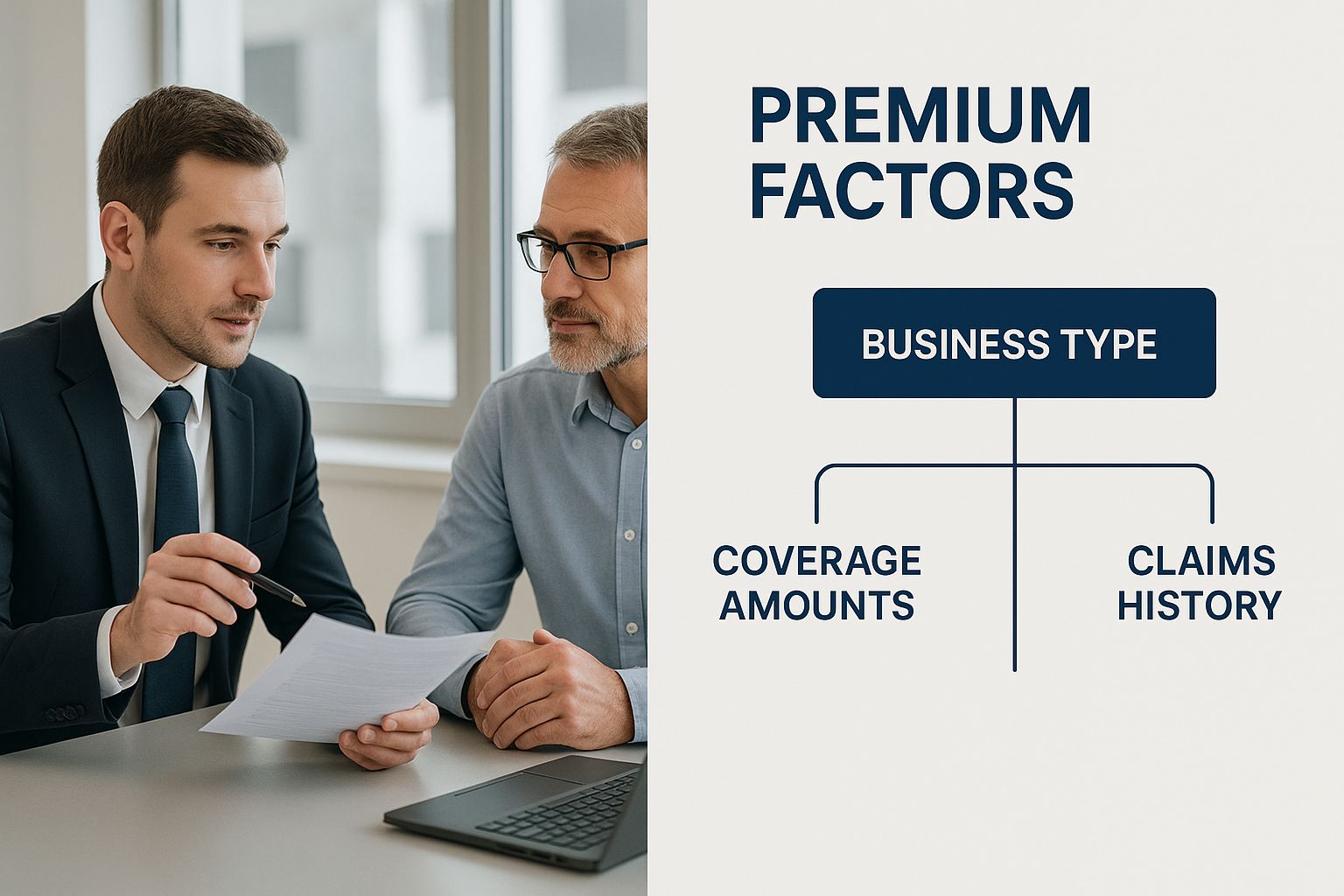
Figuring out what drives the cost of your commercial auto insurance can feel like trying to crack a code. While broad market trends play a part, the real story is written by the details of your business. Insurers aren't just glancing at your accident record; they're doing a deep dive into your entire operation to predict the likelihood of a future claim.
Think of it this way: the more you can show a solid commitment to safety and managing risk, the better your rates will be. Every piece of information, from the trucks in your yard to the training you give your drivers, helps them build a picture. Taking control of these factors is the single most powerful way to manage your insurance costs.
Your Industry and Business Operations
The first thing an underwriter looks at is the very nature of your business. It's a simple question of risk. A local florist making a few deliveries in a small van is in a completely different risk universe than a long-haul trucking company running rigs across state lines.
Insurers have a sharp eye for the details that signal higher risk. They'll consider things like:
- What You Haul: Transporting hazardous materials or high-value equipment will always cost more to insure than moving office supplies. The cargo itself carries risk.
- How Far You Go: A business that stays within a 50-mile radius is seen as much less risky than one whose vehicles are hundreds of miles from home base every day.
- When You Operate: Running vehicles late at night or during chaotic rush hour traffic? Insurers know accident frequency spikes during these times, and your rates will reflect that.
This is a big reason why commercial auto has become such a tough market. While other commercial insurance lines have seen rates drop, commercial auto premiums have jumped between 5% and 25%, depending heavily on the industry and loss history. This is partly fueled by "social inflation"—skyrocketing litigation costs that push premiums up for everyone. You can learn more about these 2025 commercial insurance shifts on nickersonins.com.
The Vehicles in Your Fleet
The specific vehicles you use are another huge piece of the premium puzzle. It’s not just about make and model. Insurers analyze everything from a vehicle's weight and value to its specific purpose.
Here are the key vehicle traits that move the needle on your rate:
- Vehicle Weight and Size: It's pure physics. A heavy dump truck or semi-trailer can cause catastrophic damage in a way a standard cargo van can't. That potential for a massive claim means a higher premium.
- Vehicle Value: The cost to repair or replace your vehicles after an accident directly impacts your physical damage rates (Collision and Comprehensive). A fleet of brand-new, top-of-the-line trucks will naturally cost more to insure than older, less valuable models.
- Safety Features: This is where you can be proactive. Equipping your fleet with telematics systems, dashcams, and automatic emergency braking shows you're serious about safety, and many insurers will reward you with discounts.
To an insurer, a vehicle's Gross Vehicle Weight (GVW) is a direct measure of liability risk. The bigger and heavier the truck, the greater the potential for a devastating—and expensive—accident. That reality is baked right into your premium.
Your Drivers and Claims History
At the end of the day, it all comes down to the people behind the wheel. You can have a perfect fleet of new trucks, but if your drivers have poor records, your rates will soar. Insurers will pull the Motor Vehicle Record (MVR) for every single driver you want to cover.
A history of speeding tickets, at-fault accidents, or other moving violations is a massive red flag. On the flip side, a team of experienced drivers with clean records is your single best asset for getting a good rate.
Your company's own claims history is just as critical. A business with a pattern of frequent claims—even small ones—signals a high-risk operation to an insurer. This is why a rock-solid driver safety program isn't just a good idea; it's a financial necessity. Proving that you're actively working to prevent accidents is one of the best things you can do for long-term cost control. For a deeper look into actionable strategies, check out our guide on how to lower your car insurance costs.
How to Choose the Right Policy for Your Business
Picking the right commercial auto insurance isn't just about finding the cheapest quote—it’s a strategic move to safeguard your company's future. The process can feel overwhelming, but when you break it down into a few manageable steps, it becomes much clearer. The goal is to build a policy that fits your business like a glove, not some off-the-rack solution.
It all starts with a serious look at your real-world risks. Think beyond just counting your vehicles. You need to dig into how they are used, day in and day out. This isn't an inventory check; it's a deep dive into your potential liabilities.
Accurately Assess Your Business Risks
To get the right protection, you first have to know exactly what you’re protecting against. A quick, surface-level assessment is a recipe for dangerous coverage gaps.
Start by asking yourself some pointed questions:
- What are my vehicles actually doing? Are they making light deliveries around town, or are they hauling heavy loads across state lines?
- Who is behind the wheel? Do you have a team of seasoned pros with clean records, or are you hiring newer drivers who might need more oversight?
- What am I hauling? The risk profile for a van carrying office supplies is worlds away from a truck transporting expensive machinery or hazardous materials.
This kind of detailed analysis shines a spotlight on your biggest exposures, telling you exactly which types of commercial auto insurance coverage to prioritize. While you're focused on your vehicles, don't forget that other business risks are always lurking. To see how different policies fit together, it’s worth learning more about why general liability insurance matters for Florida businesses.
Compare Quotes and Insurer Strength
Once you have a crystal-clear picture of your needs, it’s time to shop around. But be careful. Just grabbing the lowest price is a classic mistake. That rock-bottom premium is often cheap for a reason—it might come with a sky-high deductible, restrictive terms, or an insurer that’s impossible to deal with when you file a claim.
Instead, look at each quote as a complete package. A slightly higher premium could be a smart investment if it buys you better coverage limits or a claims department that actually answers the phone. This is also where an insurer's financial health is critical. You need a carrier that has the financial muscle to pay out a major claim without breaking a sweat.
The best policy is a partnership with an insurer you can trust. Look for carriers with strong financial ratings (like an "A" from A.M. Best) and solid customer reviews on their claims process.
Fortunately, the market is well-equipped to handle big hits. The U.S. commercial insurance market has now surpassed $1 trillion in policyholder surplus, which is the key measure of an insurer's capital strength. This massive financial cushion, backed by over $700 billion in global reinsurance capital, helps keep things stable even after years of major catastrophes. You can find more insights on the global insurance market on marsh.com.
Finalize Your Coverage Limits and Deductibles
The last step is working with your insurance pro to lock in your coverage limits and deductibles. Your limits need to be high enough to protect your business assets if you get hit with a worst-case-scenario lawsuit. A $1 million liability limit is a common starting point, but depending on your industry, you might need significantly more.
Your deductible is what you pay out-of-pocket before your insurance kicks in. A higher deductible will lower your monthly premium, but you have to be honest with yourself: can your business comfortably write that check on short notice? Finding that sweet spot between your premium cost and your deductible is the final piece of the puzzle to crafting a policy that truly works for you.
Common Questions, Answered
Do I Need Commercial Auto Insurance for My Personal Vehicle?
This is one of the most common questions we get, and the answer is almost always yes. If you use your personal car for anything business-related—like driving to a job site, making deliveries, or meeting with clients—your personal auto policy won't have your back if you get into an accident.
Most personal policies have a "business use exclusion," which is exactly what it sounds like. It's a hard line that means you need commercial auto insurance coverage the moment a vehicle becomes a tool for your work.
What Are the Main Differences Between Personal and Commercial Policies?
The biggest differences really come down to three things: liability limits, the types of coverage available, and of course, the cost.
Commercial policies are built to protect a business, so they offer much higher liability limits, often starting at $1 million or more. They also include specialized coverage you can't get on a personal policy, like Hired and Non-Owned Auto. Finally, the price is based on business-specific risks—like the type of vehicle you drive, how it's used, and who is behind the wheel.
How Can I Lower My Commercial Auto Insurance Premiums?
You have more control over your rates than you might think. A great starting point is to implement a formal driver safety program and make a point to hire drivers with clean driving records (MVRs).
Installing telematics devices or dashcams to monitor driving behavior can also lead to significant discounts. On the policy side, choosing a higher deductible can lower your premium, but just be sure your business can comfortably cover that out-of-pocket cost. The best move? Regularly review your policy with an agent to find new discounts and trim any coverage you no longer need.
Ready to make sure your business vehicles have the right protection? The experts at MyEasyRate Insurance can build a policy that fits your exact needs and budget. Visit us online to get your free quote today.