

If you own or lease a physical space for your business, commercial property insurance isn't just a good idea—it's the financial backstop for everything you’ve built. It's the policy that protects the tangible things your business can’t operate without: your building, your equipment, your inventory, and even your furniture.
Think of it as a financial shield against disasters like a fire, a major theft, or a hurricane. One bad day could otherwise mean financial ruin.
Your Business's Financial Shield Against Disaster

Imagine the physical core of your operation—the storefront, the warehouse, the office. Commercial property insurance wraps that core in a protective layer. Every business, from a local coffee shop to a sprawling manufacturing plant, depends on physical assets to make money.
Without this coverage, a single fire or storm could wipe out years of hard work, forcing you to pay for devastating repairs and replace everything out of your own pocket. It's a risk few businesses can afford to take.
And it's not just for property owners. If you lease your commercial space, don't assume your landlord's policy has you covered. It doesn't. Their insurance protects the building shell, but everything inside that belongs to you—your computers, your stock, your machinery—is completely unprotected without your own policy.
Who Needs This Essential Coverage?
The short answer? If your business relies on physical assets to operate, you need this coverage. It's that simple. This includes businesses like:
- Retail Store Owners who need to protect both their storefront and all the inventory inside it.
- Restaurant and Cafe Operators with thousands invested in kitchen equipment, furniture, and food stock.
- Manufacturers who depend on specialized machinery and warehouses full of raw materials.
- Office-Based Businesses that own valuable computers, servers, and office furniture.
A solid commercial property policy is the bedrock of any real risk management plan. It ensures a physical disaster doesn't automatically become a financial one, giving you the money you need to rebuild and get back to business quickly.
The whole point is business continuity. When a storm rips the roof off your building or a burst pipe floods your storeroom, the right policy provides the funds to get back on your feet. It turns a potential catastrophe into a manageable problem.
To make it clearer, here’s a quick summary of the core assets a standard policy is designed to protect.
Commercial Property Insurance Coverage At A Glance
| Asset Category | What It Typically Protects |
|---|---|
| The Building | Covers the physical structure you own, including fixtures, permanently installed machinery, and outdoor signs. |
| Business Personal Property | Protects the contents inside your building, such as furniture, computers, equipment, and inventory. |
| Property of Others | Covers customers' property that is temporarily in your care, custody, or control (e.g., a computer you are repairing). |
This table covers the basics, but a policy can be tailored with specific additions to cover unique risks your business might face.
What A Standard Policy Actually Protects
 gaps in your coverage.
If you skip this step, you might find out the hard way that you’re only partially protected when disaster finally hits. Tailoring your policy is all about making sure your safety net is woven to handle the real-world risks your business faces.
Covering Your Cash Flow With Business Interruption Insurance
This is one of the most important endorsements you can get, period. If a fire destroys your restaurant, your property policy pays to rebuild the building. But what about the months of lost income while your doors are shut for repairs? That’s where Business Interruption Insurance saves the day.
It’s designed to replace that lost income and cover your ongoing bills so you can stay afloat. That includes things like:
- Employee Payroll: So you don’t lose your essential team members.
- Rent or Mortgage Payments: Because the landlord still wants their check.
- Taxes and Loan Payments: Helping you keep your finances stable during the shutdown.
This single add-on is often the difference between a temporary hiccup and a permanent closure. For more ways to protect your income, check out our guide on disability insurance for business owners for other valuable strategies.
Protecting Your Essential Machinery
Next up is Equipment Breakdown Coverage. Your standard policy protects your equipment from outside forces like a fire or a thief. But what happens when the damage comes from the inside? If your HVAC system suddenly dies, a production motor burns out, or a power surge fries your servers, this endorsement pays for the repair or replacement.
This is a non-negotiable for any business that relies on pricey or specialized equipment—think manufacturers, restaurants, or medical offices. A single mechanical failure can bring your entire operation to a screeching halt.
Key Insight: Equipment Breakdown coverage is for when your machinery fails on its own. It's a risk totally separate from external disasters like storms or theft, plugging a very specific—and very common—hole in a standard policy.
Guarding Against Catastrophic Events
Finally, you have to know what your policy doesn’t cover. Standard commercial property policies almost universally exclude damage from floods and earthquakes. A burst pipe inside your shop is covered; rising floodwaters from a hurricane are not.
If your business is in a region prone to these events, you have to buy separate, specialized policies to be protected. There’s no way around it.
It also pays to know what’s happening in the insurance market. For example, reports in early 2025 showed the market softening a bit, with insurers offering more competitive prices despite worries about a big hurricane season. That kind of environment can open up opportunities for business owners to lock in better rates, so it pays to stay on top of commercial insurance market trends.
Understanding What Drives Your Insurance Cost
Ever wonder why a modern warehouse in a quiet suburb pays less for commercial property insurance than an older, multi-tenant building smack in the middle of downtown? It’s not random. Insurers use a logical framework to figure out your premium, and it all comes down to four key elements that tell the story of your property’s risk.
This framework is called COPE, which stands for Construction, Occupancy, Protection, and Exposure. Getting a handle on these factors gives you a clear picture of what’s driving your costs and, more importantly, shows you where you might have some control to get a better rate.
Construction: Your Building’s Bones
First up, insurers look at what your building is made of. Is it a modern fortress of fire-resistant steel and concrete, or is it a classic wood-frame structure? A building built with materials that can shrug off a fire or stand up to heavy winds will always be cheaper to insure.
It's simple, really. A brick building is far less likely to be a total loss in a fire than a wooden one. That lower risk translates directly into a lower premium for you. They’ll also look at the age and condition of your building's guts—the plumbing, electrical, and HVAC systems are a huge part of the equation.
Occupancy: How You Use The Space
Next, what’s happening inside your building? To an insurer, a quiet law firm is a world away from a bustling restaurant with open-flame cooking or a workshop full of flammable chemicals. Occupancy is all about the kind of business activities taking place on the property.
Even your neighbors matter. If your boutique shop is right next to a high-risk tenant like a dry cleaner, your premium could be higher just because of the risk next door.
The infographic below breaks down the major pieces that go into your final insurance premium.
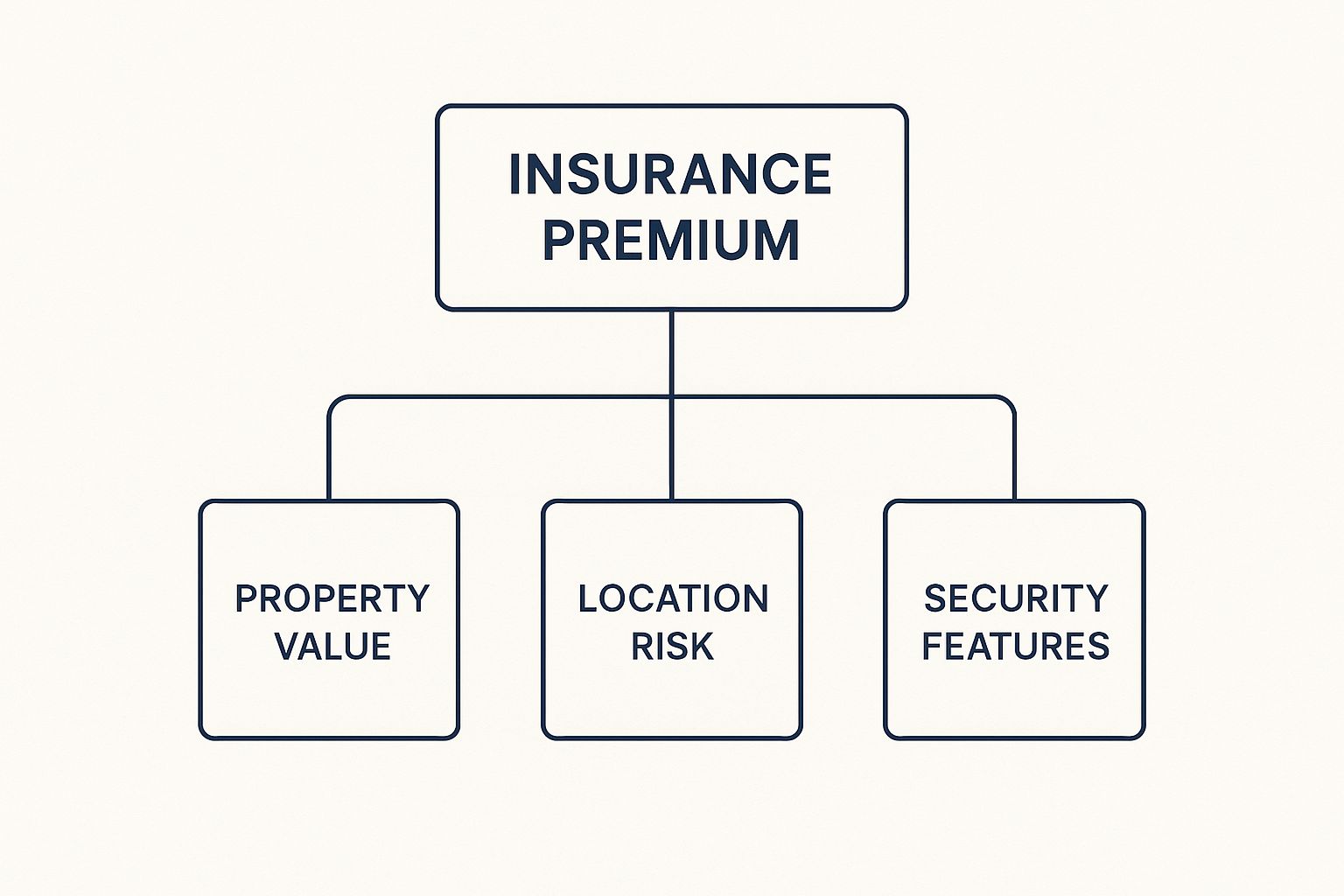
As you can see, an insurer's calculation is a balancing act between your property's inherent value, the risks in its environment, and the safety measures you have in place.
Protection and Exposure: Your Defenses and Your Surroundings
Protection is all about what you’ve done to prevent or minimize a loss. Think of it as your property’s defense system. This includes things like:
- Fire Protection: Do you have a modern sprinkler system? Are your fire alarms monitored 24/7?
- Security Measures: How about burglar alarms, security cameras, and heavy-duty locks?
- Proximity to Help: How close are you to the nearest fire station and fire hydrant? Every second counts.
Finally, exposure looks at the risks outside your four walls. This covers everything from the local crime rate to how vulnerable your property is to natural disasters. The growing threat of severe weather has a massive impact here. For instance, with global insured losses from natural catastrophes expected to hit $145 billion by the end of 2025, properties in high-risk zones for hurricanes, wildfires, or tornadoes will always see higher premiums. You can get a deeper dive into these market shifts by checking out the 2025 commercial property insurance outlook.
How To Navigate The Claims Process After A Loss

It’s the moment every business owner dreads—a fire, flood, or major theft. The feeling can be completely overwhelming, but knowing exactly what to do can make all the difference in getting your business back on its feet.
The minutes and hours right after an incident are critical. How you respond impacts not just safety but also how smoothly your commercial property insurance claim goes. Let’s walk through the steps to get you from crisis to resolution.
Your first move has nothing to do with property. It’s about people. Make sure every employee and customer is safe and accounted for. Period.
Once you know everyone is okay, your next job is damage control. Think triage. You need to prevent the situation from getting worse. This might mean throwing a tarp over a busted roof to keep the rain out or boarding up a shattered storefront window.
Your Initial Action Plan
Before you move a single thing (unless it’s to prevent more damage), document everything. Pull out your smartphone and become a crime scene investigator.
Take tons of photos and videos. Get wide shots to show the full scope of the damage, then move in for close-ups of specific equipment, inventory, and structural issues. Get every angle you can think of. This visual proof is gold.
With evidence in hand, it’s time to call your insurance agent or carrier. Don’t wait. The sooner they know, the faster they can get the ball rolling. Be ready with:
- Your policy number and basic contact info.
- A quick, clear description of what happened.
- Your initial photos if you can text or email them right away.
Important Takeaway: The single best thing you can do for your future self is to create a detailed property inventory before disaster strikes. A simple spreadsheet listing your equipment, furniture, and inventory with purchase dates and values will be your most powerful tool in a claim.
The Adjuster's Visit and Settlement
After you file the claim, the insurance company will assign an adjuster to your case. Their job is to inspect the damage, figure out what it will cost to fix, and see how it all lines up with your policy.
Make sure you’re there for their inspection. You can point out damage they might otherwise miss and answer questions on the spot.
Hand over all your documentation—your photos, your inventory list, and any big-ticket receipts you have. After the visit, the adjuster will file a report, and the insurer will come back to you with a settlement offer.
Keep in mind that a property claim can be linked to other issues. If an employee was hurt when the damage occurred, for example, other coverages come into play. You can check out our guide to workers' compensation in Florida to see how these policies can interact.
Review the settlement offer very carefully. Does it match up with your own records and the repair estimates you’ve gathered? If it feels low, don't just accept it. Push back with your own contractor bids and the proof you collected. A well-documented claim is your best leverage for a fair and fast settlement.
Common Misconceptions That Can Cost You Money
Some of the most expensive gaps in commercial property insurance start with simple, dangerous assumptions. Believing these common myths can leave your business wide open to financial ruin right when you can least afford it.
Let's clear the air and bust a few of the costliest misconceptions out there.
Myth 1: “My Landlord’s Policy Has Me Covered”
This is probably the biggest and most common mistake a business owner can make. Your landlord's insurance policy is designed to protect their investment, not yours.
It covers the building itself—the roof, the walls, the foundation. Everything you own inside that space, from your inventory and computers to your custom-built shelving and reception desk, is entirely your responsibility. If a fire, burst pipe, or major theft hits, your landlord’s insurer will pay zero to replace your business assets.
Myth 2: “My Policy Covers Everything”
Another widespread belief is that a standard policy is a catch-all for any disaster imaginable. It’s not. Most business owners are shocked to discover that damage from floods and earthquakes is almost always excluded from a basic policy.
If your business operates in an area prone to these events, you absolutely must buy separate, specific coverage for them. Don’t wait until after a disaster to find out what’s hiding in your policy's exclusion list.
It’s a hard lesson to learn after a loss: your policy only covers what is explicitly stated or not specifically excluded. Assuming you're protected from "everything" is a direct path to an unpaid claim.
Myth 3: “Any Payout Is a Good Payout”
Finally, you need to get crystal clear on how your insurer will pay you after a claim. This isn't a minor detail; the difference can be tens of thousands of dollars, fundamentally changing your ability to recover.
Your property can be valued in two very different ways:
- Replacement Cost (RC): This is the one you want. It pays what it costs to replace your damaged property with brand-new, similar items at today's prices. There's no deduction for wear and tear.
- Actual Cash Value (ACV): This is far less favorable. It pays the replacement cost minus depreciation. That five-year-old server you depend on? An ACV policy might only value it at a fraction of what a new one actually costs, leaving you to cover the rest.
Opting for an ACV policy might shave a little off your premium now, but it can create a massive financial hole when you're trying to rebuild. Always, always confirm which valuation method is in your policy.
Got Questions? We’ve Got Answers.
Even after you get the basics down, commercial property insurance can feel a little tricky. Here are some quick, no-nonsense answers to the questions we hear most often from business owners.
Do I Need This Insurance If I Work From Home?
Almost certainly, yes. Your standard homeowner's policy offers next to nothing for business-related property. Think about it: if you store inventory in your garage, rely on expensive computer equipment for your work, or hold onto property for clients at your home, you're exposed. A commercial property policy is the only way to make sure those assets are properly protected.
What’s the Difference Between a BOP and a Standalone Policy?
Good question. Think of a Business Owner's Policy (BOP) as a combo meal. It bundles together property insurance, general liability, and often business interruption coverage into one convenient package. It's a great fit for small to medium-sized businesses with pretty straightforward risks.
A standalone commercial property policy, on the other hand, is like ordering à la carte. It's just for property protection. This is the route for larger businesses or those with unique, complex risks that just don't fit into a pre-packaged BOP.
How Does a Coinsurance Clause Affect My Payout?
This is a big one, so pay close attention. A coinsurance clause is a rule that says you have to insure your property for a certain percentage of its total value—usually 80% to 90%. If you don't, and you suffer a partial loss (like a fire that only damages part of your building), the insurance company can hit you with a penalty. That penalty will slash your claim payout, leaving you with a much smaller check than you expected.
It is absolutely critical to make sure your coverage limit actually reflects what your property is worth. Getting this wrong can lead to a nasty coinsurance penalty that leaves you holding a huge bill right when you can least afford it.
Trying to piece together the right commercial property insurance doesn't have to be a headache. You don't have to figure it out alone. The experts at MyEasyRate Insurance are here to help you find the perfect policy to protect your business assets. Get a free, no-obligation quote today at https://myeasyrate.com and lock in your financial future.